← All speeches
28 November 2022
Zhulkarnain Rahim
Speech at the Section 377A and Constitutional Amendment Debate
Chua Chu Kang GRC, PAP, MP
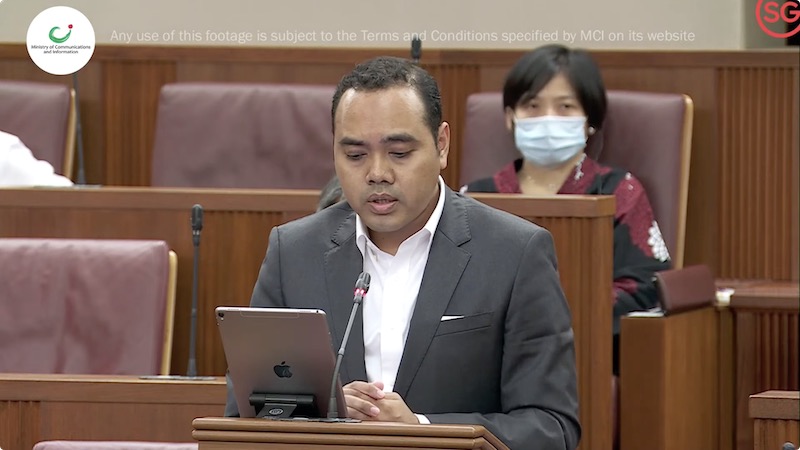
Mr Speaker, Sir, I will focus my speech on two main areas; the legal context behind the necessity for the repeal of Section 377A, which I will deliver in Malay, and the need to support families and especially parents and educators in navigating the post-repeal of Section 377A in Malay.
I will touch on the need to repeal Section 377A of the Penal Code in light of our recent Court of Appeal decision. To be precise, our constitution is the supreme law of the land. If any other laws contradict the constitution, they are invalid and void. In recent years, there have been many challenges and court rulings on the constitutional status of Section 377A. The argument is that this section violates our country’s constitution.
Following the recent ruling this year, the Minister for Law and Home Affairs, Mr Shanmugam and our Attorney General, advised that there is a strong likelihood that Section 377A will be repealed if it is further challenged in upcoming court cases. The Court of Appeal in the Tan Seng Kee case had opined that the section was possibly not in line with our constitution’s Article 12 which is the right to equal protection of the law. This is because the section only criminalizes homosexual activities between men and not generally. This may go against the reasonable classification test of our Constitution’s Article 12 interpretation in the Syed Suhail case.
However, due to the assurance given by Prime Minister Lee Hsien Loong in 2007 and the Attorney General in 2018 that this section will not be enforced, the Court of Appeal found that there was no need to make a decision on the constitutionality of Section 377A at this juncture. And the court had no locus standii or right to take action to court. This is due to the doctrine of legitimate expectation or the doctrine of legitimate expectation. But the Court of Appeal acknowledged that the Attorney General now or in the future may change the policy at anytime. This means that the Court’s opinion on locus standii or legitimate expectation doctrine may also change anytime.
Therefore, it is not a matter of if but when Section 377A will be repealed in court if another case is brought up to court. I actually agree with the government’s approach to debate the issue in Parliament and not leave it for the court to make a decision at a later date. Although our Singapore society remains conservative on matters of marriage and family, most of us do not want anyone to be jailed just because of their activities under the section. Although we remain different in terms of religion, race, values or lifestyles, we are all human. And every one of us has the same right to be protected under fair and equal laws for all citizens.
The constitutional amendment proposed today is important as it aims to protect laws and government policies based on the definition of family and marriage between men and women. With this protection, no cases can be brought to court to challenge the laws defining marriage between men and women. And also government policies based on the definition of marriage including public housing, education and media policies.
Mr Speaker, Sir, this Bill sends a signal that everyone must be equally protected under the law. At the same time, the amendment to the Constitution clarifies Parliament's role to protect, safeguard, support, foster and promote the institution of marriage. The new Article 156, subsection 3, protects from a constitutional challenge the laws defining marriage as a union between a man and a woman, and also laws and policies based on a heterosexual definition of marriage.
Notwithstanding this, I have met many residents in Keat Hong and Chua Chu Kang, and members from various organisations and charities, including Malay-Muslim organisations, who are uncertain as to what the future changes these amendments will bring. I think it is important to actively engage families and parents on this issue, and provide them with various avenues of counselling or parenting support. The same goes for our teachers and educators too. For the Muslim community, a common feedback from mosque or organisation leaders is that there is a need for clearer guidelines or capability training.
The new Article 156, subsection 2, states that the government and public authorities may in the exercise of the executive authority promote the institution of marriage through public housing, education and media policies that promote and safeguard the institution of marriage. In this regard, may I ask what are the plans of the government to achieve this stated objective, to promote and safeguard the institution of marriage, and in particular, whether there are any plans to provide families, especially parents, with counselling or parenting support. In this regard, such parenting support or counselling should also provide for a faith or value-based support if such is available, so that the individuals concerned would choose what suits them best.
Also, it is important to preserve the freedom of conscience in our schools, businesses and religious institutions, so that our fellow Singaporeans are free to practise their belief, their faith or otherwise, without any fear of cancellation or reprisals against them. I welcome the announcement by Minister Shanmugam and also by MOS Sun Xueling just now that the ministries and agencies are looking into this. May I ask whether there is an update and whether a consultation feedback process will be undertaken?
In conclusion, Mr Speaker Sir, we need to continue to stand united together as fellow Singaporeans despite our differences in faith, values or belief. Let us not let this issue divide us, but instead unite us.
Thank you.