← All speeches
29 November 2022
Xie Yao Quan
Speech at the Section 377A and Constitutional Amendment Debate
Jurong GRC, PAP, MP
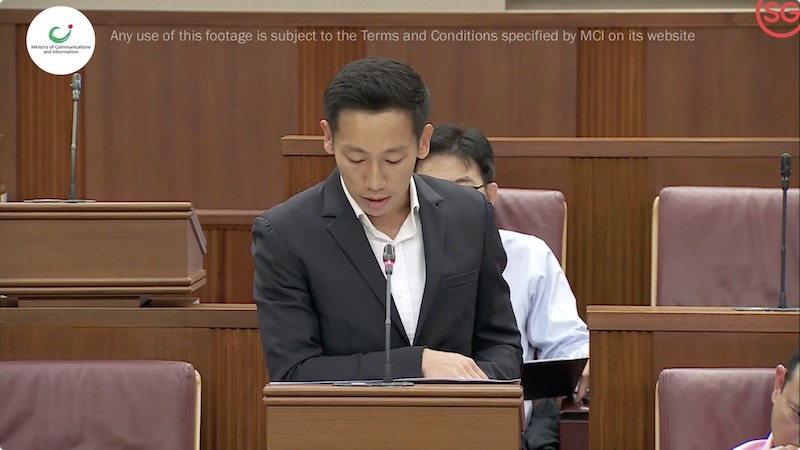
Mr. Speaker, sir, before I speak on the substantive matters concerning the Constitution amendment and the repeal of Section 377A, let me first make one point that I think has not been made enough. This is the fact that the debate that we are having here yesterday and today in this House is a milestone, a huge milestone for our evolving democracy. It reflects the political leadership of a government and a parliamentary majority who have resolved to rise to our duty, not abdicate from our responsibilities and find the political courage and gumption to confront the difficult issues head on, do what is right, even if there is no political favour to be gained, and indeed every chance of a political cost to bear.
Once the prospects of the courts striking down Section 377A in a future challenge became clear, this government of the day did not choose to unsee what it had seen. The government did not look the other way. Instead, we sprang into action, put it squarely on the agenda as our duty required us to, and set out to find a way forward for all Singaporeans, difficult as it may be. And so I say, especially to the youths who desire a more robust democracy in Singapore, I say let's celebrate this moment. Let's celebrate this moment. This is our democracy in action. This is our democracy growing stronger.
I listened to my colleagues yesterday, Mr Chris de Sousa, Mr Alex Yam, Minister Vivian Balakrishnan, Ms Jessica Tan for example, who hold very strong beliefs on the family unit and want the institution of marriage to be protected and strengthened. Nonetheless, eventually by the end of their speeches, they have also expressed their strong support for repeal in this debate. And then on the other hand, there was SPS Baey Yam Keng for example, who has been advocating strongly for repeal indeed since 2007. And yet in this debate, eventually by the end of the speech, he has also expressed strong support for protecting the institution of marriage. So very different starting points. Repeal on the one hand, protecting the institution of marriage on the other. And a broad tent of views, a broad tent of starting points even amongst PAP MPs representing various parts of our society. Yet we have found mutual accommodation. We have found convergence in support of both bills. And we have closed ranks and come together to try and bring all Singaporeans along on the way forward together in the national interest, our personal views notwithstanding, as my colleague Mr Murali Pillai has so eloquently put it. This is how a responsible governing party works. This is our democracy in action. And I am glad that opposition members and nominated members have all joined us in seizing this moment. We owe it to Singaporeans to do right by our democracy.
We discussed the difficult issues directly and above all, we stand for unity and compassion as one people. Mr Speaker, sir, now let me get to the substantive matters. First on the repeal of Section 377A. I'll start with a quick story. I once asked two friends, husband and wife in their 30s, young parents to two kids and we were talking about their expectations of their children. And I asked them, what if their son turns out to be gay and wishes to bring his partner home to meet them? What would they think? Without missing a beat, they replied me, they cannot even begin to contemplate and imagine such a scenario. Now I don't think they belong to a minority of young parents today, far from it. Yet if their son does turn out to be gay, I would make a guess that they will, one, love him all the same and, two, they will certainly not want their son and his acts of intimacy with his partner, consensual, in private, to be labelled as criminal.
Why should their son be labelled a criminal? This I think is the crux of the Section 377A issue. Regardless of our views on homosexuality, I think we can generally agree that we know a gay friend or even family member and we love and respect him like we do any other friend or family member. But we have very little reason, really, to see him as a criminal. I believe this is the prevailing morality of our society and because our laws ought to reflect the morality of our society, repealing Section 377A and decriminalising gay sex is really the right thing for us to do. And I'm glad we are doing it.
Now we could very well stop here. Legislatively, there is no obligation or inevitability that as we decriminalise gay sex, we will also protect the institution of marriage. It is a deliberate act of Parliament, a carefully considered and balanced decision and move, to do both at the same time. And we do it because we know that, taken together, this set of arrangements will be one that our society as a whole can probably accept and it can point a way forward for all of us. Going back to the story of my two friends, the young parents, yes, if their son does turn out to be gay, they will certainly not want their son's private activities to be criminal but I think it will be much less certain if they will accept the notion of a son-in-law or of a grandchild or grandchildren within the context of a marriage between their son and his gay partner.
And I think they would also completely understand if their friends were to turn to them and say, look, we really will not agree to allowing your son to marry here in Singapore because it runs against our beliefs and it runs against what we would like our children and our grandchildren to believe about marriage or at least what we would like our children and grandchildren to see and hear for themselves before forming their own conclusions.
On marriage, I think this is the prevailing morality of our society and our laws and policies should also protect this, even as we repeal the law on gay sex. Indeed, it seems from a survey conducted by Today just two months ago that younger Singaporeans generally think this way too. Sixty-eight per cent view the repeal of 377A positively and at the same time an almost equal proportion wishes to uphold the current definition of marriage between one man and one woman.
Now, let me also say this, some have commented that this is effectively, where we are today, is effectively one step forward and two steps back for the gay community. I have to respectfully disagree. I think this is real progress. Gay sex is decriminalised in Singapore, finally, and at the same time we are coming together as a society and coming to terms with the reality that a majority of us are not yet ready to give up our fundamental beliefs, including our marriage, and so let's find a balance. Let's find mutual accommodation. This is a mark of our maturing society. This is real progress.
Now, some on the other hand have characterised the repeal as a capitulation by the government and society at large to the relentless campaigns and militant advocacy of some gay rights activists. I think this is quite unfair too. I believe instead that this change is about all of us, our society as a whole, maturing, progressing organically. Change takes time and this change has taken quite some time, but this change has not been precipitated by the narrow words or actions or deeds of a few.
I think this change represents part of our broader progress towards becoming a more inclusive society in various other dimensions like wage level, age, disabilities, mental health, and yes, we have become more inclusive on the dimension of sexual orientation too.
Sir, in Mandarin please. I would like to ask you, as parents, if one day your son tells you, Dad, Mum, I am gay, I have a partner, I would like to bring him to see you, what would you think? What would you say? This might be a very confusing and confusing idea. I am not willing to see any parents who would go through this kind of challenge. But if this is the reality, I think our reaction would be, first, we still love our children and we would not want our son to be considered a criminal for his sexual orientation and sexual behaviour. Second, this is the core issue of the 377A Act, no matter what kind of attitude and concept we have towards gay couples, we should have friends and family members who are gay in our life, they deserve to be loved and respected just like anyone else. I think we can all agree that we have no reason to consider the sexual behaviour of gay couples as criminal for their sexual orientation. This is not fair and not just.
So I support the 377A Act, this is what we as a society should do, and there is no other option. Of course, I also understand that many countries are worried about the consequences of the 377A Act, and what kind of promotion and debate gay couples and human rights activists will have. If the next step after the 377A Act is the recognition and approval of gay marriage, then where should the standard and core values of our society go? These concerns of the Chinese are very fundamental and very important.
And because of this, the government has proposed to amend the constitution while abolishing the 377A Act to protect the current definition of marriage. Yesterday, Secretary of State Sun Xueling pointed out the great thoughts that the government has put into the 377A issue and the concerns and considerations of all groups of society. I want to say that these two bills also reflect the political courage, courage and courage that the government and the National Assembly should have.
Although the 377A issue is difficult, we have not retreated, we have not lost our responsibility. In ancient times, there was a saying that the country is governed by the people, and the people are the foundation. The government should be governed by the people, and the people are the foundation. The most fundamental rule of governing the country is to benefit the people. The government has done this by following the two bills, and by following the two bills, the government has done this. The most important thing in political education is to make the government order work. So the People's Action Party has not raised the party's side in these two bills. The ruling party should govern by its own will, and let the government order work. The ruling party has done this. This is an important victory for all the people in our democratic system and democratic process.
So where do we go from here? My hope is that all sides will continue engaging with each other, and do so with ever greater depths of mutual respect, understanding and empathy. And it starts with avoiding unhelpful assumptions. For one, gays and lesbians are not a monolith. Not all homosexuals are judicial activists, and judicial activists do not speak for all homosexuals. At the same time, not all social conservatives are Christian or Muslim. Indeed, many conservatives are either of other religions or not religious at all. Their socially conservative views, while deep-seated, are not religious in nature.
I also hope that our engagements going forward will be in the real world, offline, not in social media where certain narratives get amplified much more than others. Social media creates echo chambers, and not all equally. Some chambers may be small, but their echoes are especially loud, and they reverberate well beyond the realms of the chambers themselves. We have Singaporeans who are concerned with how and what social media is buffeting us with, and I think rightly so. We need safe spaces in the real world where all views can come forth and be heard equally, where we can get a good sense of the real balance of views amongst all of us. And in these safe spaces, no one should have to labour under the fear of name-calling or being cancelled, especially by bad actors under the guise of anonymity.
Mr Speaker, with this, I support both bills. Thank you.