← All speeches
28 November 2022
Vivian Balakrishnan
Speech at the Section 377A and Constitutional Amendment Debate
Holland-Bukit Timah GRC, PAP, Minister for Foreign Affairs
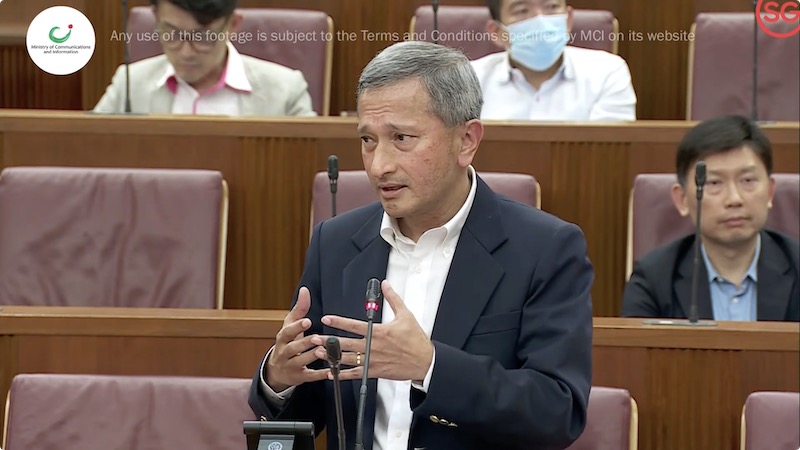
Mr Deputy Speaker, this is clearly not a matter of foreign policy. But since my wife and I celebrate our 35th anniversary today, and I am the proud parent of four children and four grandchildren, I thought this was a debate which I sought the opportunity to share some personal perspectives and that of my residents.
I start with three propositions. Traditional marriage has been venerated in all societies, all civilisations since time immemorial. First point. Second, a marriage is far more than a legally binding contract between two consenting adults. Third, the rights of children, in fact, are paramount, and in fact trump even the mutual happiness of parents. So I start off with these three propositions for your consideration.
My life was transformed the first moment I held my daughter in my arms. For the first time in my life, I held a precious new unique human being, utterly dependent on my wife and me. She may have been delivered by my wife, but my daughter and now her children, my grandchildren, have a future that goes hopefully far beyond me. That moment was also the time that I realised just how much my parents loved me. And with some guilt, I realised that actually all of us cannot possibly love our parents as much as our parents love us. And every single one of you here who has been a parent, I think has had that experience. And what it shows is that love flows down the generations. It's actually mainly one way. And so parental love is really about paying it forward.
And it is this focus on forward and the future that drives us, drives all parents, to give the best possible start to their children. This is what makes us so focused on leaving the world in a better state for our children to inherit. And you see, it is this focus on the future, on protecting, nurturing, saving, investing, building. It is this future-oriented focus that affects the tone of our society. And frankly, even in Parliament, it's why for me there's no such thing as saving too much for the future, because it's for them and not for us. And even as we do that, we are simply in fact replicating what our parents and grandparents did for us.
And so this is why I believe all societies, all religions, have always conferred a sacred status on the institution of marriage. And this is why this is a key pillar, a key prescription for human progress in societies everywhere since time immemorial. The second point is that a marriage is far more than a legally binding contract between two consenting adults for the sake of their mutual happiness. My wife has often reminded me of an aphorism. The best gift you can give your children is to love their mother. Initially, I found this advice bemusing, but the more I thought about it, actually this advice makes perfect sense. Because you see, children, and in fact think back to your own childhood, children need that reassurance, that sense of stability, of knowing that both parents are in a committed, loving relationship for the long term.
And that the parents, both parents, will always be there for them. So in fact, the way we approach our marriage is not and should not be about just optimising the happiness of two adults, but really for the sake of our children and their future. Because if we are successful and if we are blessed, then we are good role models for our children. But our mistakes or sometimes our wrong choices have profound impact and implications on our children. So my wife is right. Love the mother of your children.
My third point is that every child has a biological father and mother. But it is not just a matter of biology and genes and chromosomes. But think back to your own childhood. Our mothers and our fathers played essential, complementary, but not identical roles. Complementary, but not identical roles. And when I served as Minister in the Ministry of Culture, Culture and Tourism, I studied the problem of children in juvenile homes or with dysfunctional social circumstances. The single most important factor I often found recurring was an absent father.
And that is why one of the things which I am proudest about was to have been one of the people behind the founding of Fathers for Life. So yes, I do believe absolutely, with no apology and with no reservations, in the traditional family form as an ideal. One man, one woman, committed to each other to bring up their children in the context of a stable marriage. But having said that, we also need to acknowledge that not everyone will be so blessed and enjoy such a simple, straightforward life. And that sometimes life does not go according to plan.
And all children, regardless of family circumstances, deserve our fullest support. In fact, some children, especially those in less ideal circumstances, deserve and need additional support, which this House agrees with, I am sure. Some of my friends whom I have known for the longest time are gay. And my generation came of age in the early 1980s. The AIDS epidemic had not yet been named or discovered, but it had started. And many of us were not quite aware of the threat. The veil of ignorance, the fear of embarrassment, in fact, contributed tragically to the cutting short of lives of some of my friends.
But beyond that, in fact, I am sure if you all speak to every single one of your gay friends, every single one of them has suffered the pain of rejection, of discrimination, and sometimes of violence. They have suffered that at home, in schools, and in the workplace. They crave our understanding, our empathy, our support, and our protection. And yet I think if many of us think back to our school days, I think we all fell short. I will confess to having fallen short, and for that, I apologise to my gay friends.
Unfortunately, this debate on Section 377A of the Penal Code, Section 377A has come to symbolise simultaneously two paradoxical imperatives. First, to protect the traditional family, which frankly is under considerable stress in modern days. But equally important, there is also a duty to protect our gay brothers from victimisation, and the fear, and the pain, the dejection, and the rejection. There are no simple answers to such apparently contradictory social imperatives.
SMS Sim Ann and I, Deputy Speaker Christopher de Souza and Mr Edward Chia, represent the GRC of Holland, Bukit Timah. To be frank with all of you, the majority of the feedback that we have received online and face-to-face, actually has the majority have expressed great anxiety about families, anxiety about the repeal, and a deeper anxiety about the future of families. Minister Shanmugam has explained, and I accept his explanation, that Section 377A is at significant legal risk of being struck down.
So the amendments proposed today to repeal 377A, I believe, helps us avoid that abrupt and potentially disruptive confrontation in a court of law, with a binary outcome, and with perhaps unpredictable and sometimes uncontrollable social and political consequences. So I agree with him, and I support the repeal of 377A in that context. But I also support the amendment to the Constitution that makes it clear that the question of marriage will be decided here in this House. It may not be all of us in the future, it will be a different House, but it will be decided through the political process, with all the engagement, discussion, debate, negotiations and compromises which are needed. And that is the way we need to move forward.
Similarly, to my residents who have asked for it to be entrenched, two-thirds majority, lock it up, I have to tell them that actually these are issues which no amount of legal and constitutional lock-ups will decide for the future. The values, the morals, the attitudes of our children and grandchildren, we can all do our best to instil values in them, but we have got to trust them, and trust them and entrust them with the power and the authority to make decisions in the future. So I also accept this amendment which makes it clear that the future definition, the current definition, and if there is going to be any future amendment, will be decided in this House and not in a court of law.
We do all this in full appreciation of the fact that difficult issues that go to the heart of identity, deeply held values and lived experience are best settled through careful, respectful, sincere discussions without polemics, without win-lose outcomes. And so it is in this spirit that I support the amendment's move today.
We have to find ways to continue to protect this precious and fragile institution of the traditional family and marriage, and we have to remember that the welfare and the rights of our children are paramount. Now, in practice, what that means is policies and programmes that will unambiguously support the traditional family and parenthood, including adoption rights, housing priority, baby bonuses, reproductive therapy. It also means our public messaging, our education in schools and mass media must continue to uphold these traditional family ideals.
But having said that, in my earlier versions of the speech, I tried to say we can do all this without discrimination. But actually in life, if you uplift one form, if you prioritise one type of social arrangements, inevitably it means you have to choose and it cannot be completely equal. But having said that, I believe a spirit of mutual respect and perhaps more important than anything else, compassion, can allow us to find that hopefully safe landing zone where we can protect our families and protect our gay brothers. So on that note, Mr Deputy Speaker, I support the amendments standing before the House today.
Thank you all very much.