← All speeches
28 November 2022
Sharael Taha
Speech at the Section 377A and Constitutional Amendment Debate
Pasir Ris-Punggol GRC, PAP, MP
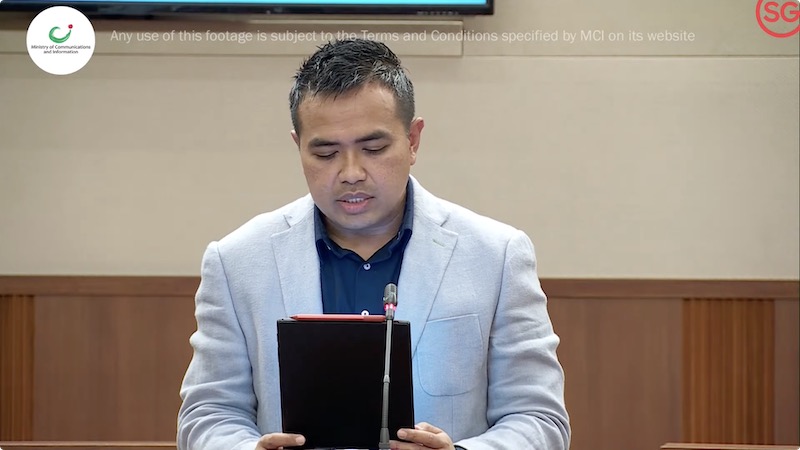
Thank you, Mr Speaker. At the National Day Rally, PM Lee's announcement that Singapore will repeal Section 377A of the Penal Code and amend the Constitution to protect the definition of marriage reflects the common agreement that many believe our gay citizens have a place in society and should not be treated as criminals. In Singapore, marriage between a man and woman remains the fundamental building blocks of a family.
Mr Speaker, I would like to touch on a few points. One, 377A as a Penal Code issue. Two, protection of current social and family norms. Three, preventing increasingly aggressive and divisive activism.
Mr Speaker, there remains some concern that the repeal of 377A would lead to a drastic change in social norms, such as how marriages would be defined in the future, sexuality educations in schools, what can or cannot be screened on televisions and in the cinema. However, we have to consider how since 2007, when 377A was last debated, social acceptance for homosexuality has shifted appreciably, as mentioned by PM Lee. Back then, it was decided not to actively enforce 377A. In addition to shifting societal values, we have to also consider the significant risk of Section 377A being struck down in the Court of Law on the grounds that it breaches the provisions of equal protection in our Constitution, as discussed extensively by Min Shanmugam earlier.
It has been unsuccessfully challenged in the past before, but it will be reckless of us to not consider this, and the ramifications if it was struck down without any protection on the definition of marriage as how our society values it.
Mr Speaker, while I appreciate that there are some reservations and concerns from certain segments of society, most of us agree that two males committing sexual acts or acts of gross indecency, as the law puts it in private, should not be punished by imprisonment of up to two years. Hence, it is only right that we consider to repeal 377A in our Penal Code. We acknowledge that we are still a largely conservative society, but our gay citizens have a place in society and should not be treated as criminals.
While in general more accepting of homosexuality now, we are also very concerned about protecting the current social and family norms. With the repeal of 377A, how can we effectively safeguard our social norms and values, and in particular the institution of marriage which is currently defined as being that between men and women? We must also understand how this definition underpins various national policies such as housing and education. Hence it is even more necessary for us to ensure that the current social and family norms are protected.
Undoubtedly, there are strong views for and against the repeal of 377A and the amendment to the Constitution. There are concerns that there will be increased activism on both ends of the spectrum, which can potentially be aggressive and more importantly divisive to our society. I think it is necessary for us to accept this as a consensus, the best possible outcome given the various viewpoints and deliberations with regards to all the various groups of people, religious, non-religious organisations and the community which has been ongoing since 2007 and before.
While we should not curtail or suppress social activism for causes that our citizens believe in, we must also caution against extreme views and actions that may prove to be divisive to our society. In time to come, should values and norms here in Singapore appreciably shift again, then we should be able to come together, sharing our views and reaching a consensus on how we best move forward. Activists in both camps did not think that they should resort to drastic measures to highlight their cause, nor should any of us be influenced by foreign developments, including pushing values from multinational corporations which are not aligned with our Singaporean values. Singapore's laws are its own and we need not follow the lead of other countries if it does not suit the values and disposition of our citizens.
Mr Speaker, in Malay please. We can see how the whole world changes according to the passage of time. Society's views have also changed. Section 377A is a law that we inherited from the British and has been made as a symbol to define marriage as between a man and a woman.
Earlier this year, in the Tan Seng Kee versus Attorney General case, the Attorney General's office found that there was a great risk that Section 377A could be overturned in the court because it contravenes the provisions for equality in our constitution. Although previous cases have failed to overturn Section 377A, we cannot take that risk.
Moreover, because such a major decision will have a great impact on other laws. For our Islamic society, we have traditions that give marriage definition. Earlier this year, I am glad that Deputy Prime Minister Lawrence Wong has given assurance that the PAP will continue to uphold policies that prioritize family and will continue to ensure that marriage will be defined as between a man and a woman.
Although this ensures that policies in Singapore will continue to prioritize family and the definition of marriage will not change, we cannot deny that the whole world has and will continue to evolve, including their own values. We should not be influenced by foreign influences, including MNCs that support values that are not in line with our society. The laws of Singapore are our laws and we should not follow developments in other countries if it is not suitable for our country.
Therefore, it is important for us to define what values we want in Singapore society. Like the Malay proverb "bend it while it is still young". It is important for us to build our family with these values so that we can instill them in our children.
As for homosexuality, we must acknowledge that there are some in our society who face personal challenges and they are sometimes ridiculed, cursed and ostracized or left without support from their families since young. In instilling values of familyhood, we must also nurture and demonstrate our religious values such as hospitality, tolerance and love for one another so that these individuals do not feel excluded and marginalized from our society.
As we each give family support, I urge our society to resort to Asatizah and Muis for assistance and guidance if needed.
Mr Speaker, admittedly, however, this is not the end of our conversation on this topic, just like all the other issues that we face in society. Society is dynamic and ever-changing. Hence, we must continue to keep future dialogues civil, rational and most importantly, beneficial for Singapore as a whole. We only have to look around us to see how issues can be made very divisive if everyone insists on their entrenched views and not hear each other out and come to a compromise.
While we would like to repeal the 377A, we would also like to protect the prevailing definition of marriage while still allowing recourse in the future. How then do we protect the definition of marriage, something which we all value as a society? By ensuring that the definition of marriage is dependent of the Parliament, and Parliament will define marriage based on the prevailing values and views of the Singaporean society at any given point of time.
At this juncture, I wish to thank PM Lee and DPM Wong for the clear assurance that the PAP Government will continue to uphold our family-centred policies and is fully committed to that, and will continue to uphold marriage as defined between men and women. In this way, even if one does not agree with the repeal of 377A, at least the definition of marriage is preserved for the time being in our Constitution.
On the other hand, for those who welcome the repeal and look beyond decriminalisation, there is room for the definitions to change when public opinion, values and norms differ. I think this is a viable compromise for our society to move forward for now.
With the points considered earlier, Mr Speaker-Sir, I do support the repeal and the amendments to the Constitution. Thank you.