← All speeches
29 November 2022
Nadia Samdin
Speech at the Section 377A and Constitutional Amendment Debate
Ang Mo Kio GRC, PAP, MP
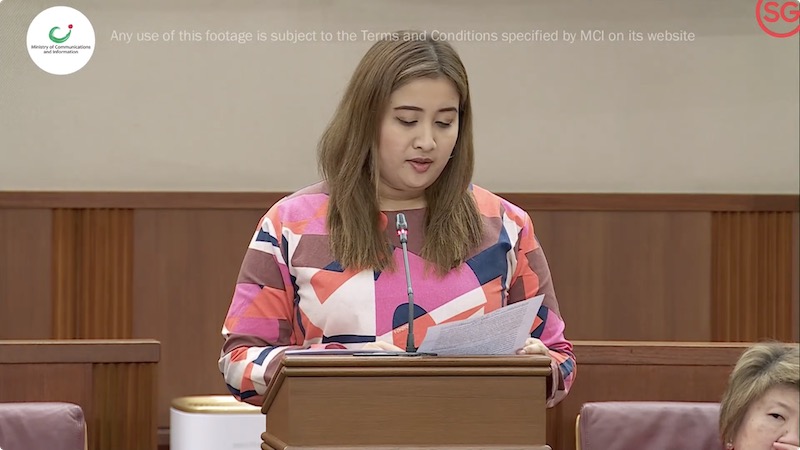
Mr Speaker, I would like to start off my speech by highlighting the significance of this debate being held in this House. The separation of powers is a deeply rooted principle in our parliamentary tradition. Parliament makes the laws, the Executive administers the laws, and the judiciary interprets and applies the laws when disputes are brought before the courts. In this House, regardless of personal beliefs, we are duty-bound to represent the different voices of Singaporeans. This is a responsibility that I do not take lightly.
Over the past few months, a number of my residents in Cheng San-Seletar have written to me, or even come down to my MPS, to express that while they do not believe that acts of intimacy between two consenting men should be a crime, they sincerely wish to preserve the definition and institution of family. Others have shared that removing criminality from homosexuality is long overdue, given that the law was introduced back in 1938. Some have also questioned if there is actually a real possibility of 377A being struck out by the courts, while others have also worried about the wider ripples of this repeal, whether this has potential to change the way that marriage is defined in Singapore, or how sexuality education will be taught to their children.
I have also heard stories of gay youth facing discrimination in their friend groups, or struggling to find acceptance among peers who do not have the capacity or vocabulary to understand them, and also of youth who hold more conservative beliefs who have been called out in schools. Sometimes these disagreements occur online, hidden under the cloak of anonymity, which emboldens individuals to speak carelessly. But loud does not always mean right, and some may feel pressured into adopting a view.
When issues are contentious, tribes are built and positions are entrenched, and conversations quickly start from an adversarial place. This environment, if left unchecked, do not allow for people to build the capacity to discuss and debate with respect, and reconcile even internal incongruence between faith, heart and mind, before coming to their own considered position.
While it may be just one section of law, and about consensual acts in private no less, 377A has come to represent much more for many over the years, concerning fundamental values of individuals in a visceral way. As elected representatives, we value every perspective shared with us. As such, this matter, which has been debated in both public and private spaces for many years, even before the 2020 National Day Rally, belongs here in this House, after years of consultation and engagement in both public and private spaces. Not in the courts, where judges must make decisions based on the information and facts presented before them, resulting in a binary decision.
Laws and policies must be guided by a careful balancing of the scales, not having the scales tipped to one side or to the other, through judicial activism, or driven by individuals with the resources to litigate. I will not belabour this point, as it has been raised by Honourable Colleagues, such as Mr Murali Pillai yesterday. This process of a judiciary intervening actively in social issues may also signal an unwillingness of elected politicians to deal with such issues ourselves, and leave such decisions to the courts, so that we don't have to assume responsibility for them.
In some countries, judicial activism has deepened polarisation in societies, for example over immigration matters in Australia and abortion rights in the US. This also results in judicial appointments themselves becoming politicised affairs. We should not foster this culture in Singapore, and so I agree with the Honourable Minister for Social and Family Development on the approach of this Bill. I appreciate that we are dealing with this now.
The decision made in 2007 to accept the legal untidiness and ambiguity of keeping the law on the books was the compromise struck by society at the time. Later in 2018, Attorney-General Lucien Wong affirmed the public prosecutor would not prosecute two consenting men for having sex in private, giving legal significance to the political compromise struck in 2007. Former Attorneys-General Walter Woon and V. K. Rajah also separately suggested that it was not desirable for the Government and Parliament to direct the AG not to prosecute offences under 377A. Following these comments, AG Lucien Wong clarified that the public prosecutor retained independence in deciding whether to pursue a case under 377A. He shared that while the public prosecutor is entitled to consider public policies in exercising his discretion, these do not fetter the exercise of prosecutorial discretion.
In all the feedback I have received, many of our people, regardless of race, language or religion, agree that acts of intimacy between two consenting men do not make them criminals. We have also generally not seen public interest or organised groups for the active enforcement of 377A. For most, the disagreement lies solely if it should be repealed. So we must ask ourselves objectively, 15 years on, should we accept the legal untidiness and ambiguity, given that over the last 15 years, there has been little public interest in seeing Section 377A enforced?
From a legal perspective, it is not quite tenable for us to keep this dead letter law, and I support the repeal.
Sir, I have heard the concerns of those who are seeking for the definition of marriage between one man and one woman to be codified in the Constitution. However, the Honourable Minister for Social and Family Development has elaborated on why such an approach is not the right one for Singapore. For this reason, I can understand the intention of the introduction of Article 156 to the Constitution as part of the package of amendments which strives to reflect a balance, protecting the existing definition of marriage from constitutional challenges, per the majority views today, while leaving space for future generations to make their own decisions based on the context of their time.
Sir, societies evolve over time, and leaders must proactively respond to the conditions of the day. The Singapore I grew up in is different from the one of my parents, and I can also appreciate that the Singapore which my children one day may grow up in could be unrecognisable from my lived experiences. To do this, while we may choose to educate and guide our families based on our own personal values, we ought to avoid passing down entrenched positions to future generations, especially in our secular shared space.
Sir, in Malay please. Since the speech of PM Lee Hsien Loong during the National Day meeting on Section 377A in 2022, many have discussed this issue, and expressed their support and opposition. Our Malay community is not a monolithic community. Every generation has a different perspective, background, and experience. In my discussions with individuals, I have heard different opinions. I would like to thank everyone who took the time to share their opinions with me.
I also had the opportunity to meet the leaders, the leaders of our Muslim community. In this discussion, many expressed their hopes that the institution of the family would be protected, alongside the implementation of Section 377A. Some shared their concerns about their efforts to manage and support family discussions on Section 377A. Some shared their personal struggles to bring peace to trust, prosperity, and society, so that they can give value to their children in line with their trust and their way of being raised, because it is something they love. However, they still insist that any help and social service given must be given out of love, and putting importance on the individual's dignity, without considering sexuality.
Tolerance and diversity in Singapore is something we have cultivated and built over the years. It exists today because our previous generation, and the current generation, agree that it is important for us to find compromise in our public space, where advocacy does not necessarily have to divide one another. On that note, I would like to finish off my speech to ask not just the members of this House, but Singaporeans at large, where do we go from here? We are not just dealing with this repeal, but other issues which may divide us.
There are two paths. The first sees us entrenched in our positions, unwilling to engage in constructive dialogue with others who may not see the world the way we do. The second sees us engaging in respectful conversation, while remaining steadfast to our own values. Path one leads to division, and we have seen the damage this has done in fractured societies. Path two leads to understanding, and in turn, peace and a more lasting prosperity. It is a path rarely paved and harder fought, and uncharted territory for many of us. In moments of crisis, we run the risk of deviating back to path one.
In the context of Section 377A, we move beyond talking about criminality in the same sentence as homosexuality, and see people as individuals for who they are. It is easy to say that we must move beyond tolerance and towards understanding, but harder to accept that we can no longer steer clear from speaking on contentious issues. I ask that we endeavour to not invalidate the lived experience of others, and that we do not fall prey to living in echo chambers. Singapore is not in a special bubble which makes us immune to these risks, and I do believe that our leaders understand that.
As a young nation, we have not had as many years to discuss and debate, or come to a landing of what we expect of each other, as well as an understanding of trade-offs. I am hopeful that efforts such as Forward SG will build up the muscle for society to do so, if done well. And such sessions are an important part of setting up a two-way mode of engagement between the Government and people, where engaging in productive dialogue with varying points of view becomes the new normal.
In closing, there are many ways to create change. Sometimes it requires us raising our voices. Most times it requires persistence and tough conversations. And always it involves time, a big heart, and the willingness to hear each other out. Ultimately, change should not be borne out of or led by fear, as fear will not protect us. I echo my Honourable colleague MP Joan Pereira's sentiments that we should come from a place of love. And I would add also about courage. Knowing that there are diverse groups who feel strongly about this, I hope that we can continue to be brave to have the tough conversations with mutual respect for our fellow Singaporeans.
Thank you for allowing me to participate in the debate.