← All speeches
28 November 2022
Murali Pillai
Speech at the Section 377A and Constitutional Amendment Debate
Bukit Batok, PAP, MP
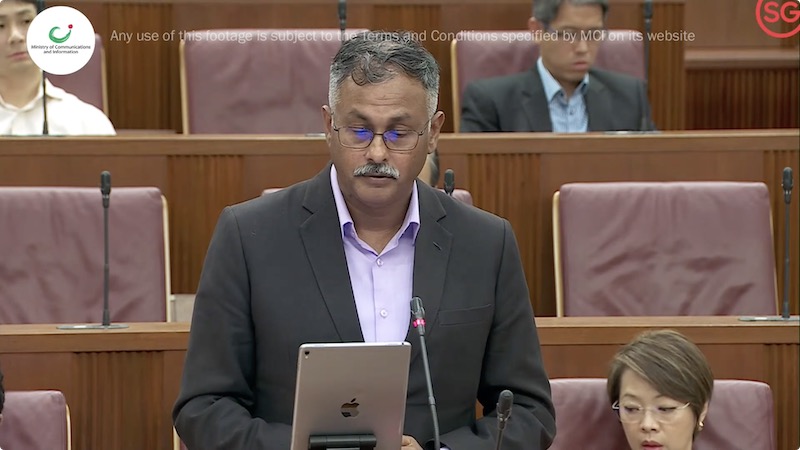
Mr Speaker, sir, one might be tempted to say that this issue is one of the most polarising and contentious socio-political issues that this House ever dealt with. The heavy correspondence that I received and numerous meetings that I had with my constituents on this matter reflects that. I am sure I am not alone in this.
Let us be clear though. Should these bills be passed, it does not mean that the underlying issues will simply go away. It will not. At the same time, the fact that we are considering these bills does signify a potential for this House to express its collective will and I heard the Honourable Leader of the Opposition say collective values as well, across party lines and decides on the basis of what is in the greater good of our country. This is what representative politics means. MPs deciding on matters based on national interests and public good, not their personal interests. The well-known politician and philosopher, Sir Edmund Burke, said that Parliament is not a Congress of Ambassadors. Members of Parliament have to decide based on national interests, and not just based on the opinions of their constituents. This is where our involvement here becomes all the more important, because we cannot decide just on the basis of our personal views. We have to decide on the basis of what is in the national interest. How best can we take Singapore forward and ensure that the future of Singaporeans will always remain bright? That is the issue.
So what is my view with respect to this issue? I understand from the Leader of Opposition that he has decided to lift the Whip. I just want to clarify that while the Whip is not lifted for the People's Action Party, it does not prevent any MP from my party to speak his views. And I will shortly speak my views too. The Whip is basically a system to deal with voting, and that is separate and distinct from clearly and honestly expressing our views.
On my view, I can be relatively brief. This is because I had already articulated my views on this matter in 2018, when I was interviewed by CNA. Then I stated my support for the repeal of Section 377A. I said that anyone, regardless of his sexual orientation, is deserving of equal treatment, dignity and respect. No one should be treated as a social outcast. I also advocated a holistic review of the matter before any legislative decision is made, to address the legitimate concerns that the repeal of Section 377A may have an impact on important institutions such as marriage and family.
I therefore have no hesitation in supporting the carefully calibrated provisions in these bills today. Repealing Section 377A is the right thing to do. Homosexual males in consenting relationships will no longer be viewed as criminals, and we would have taken a decisive step in removing the stigma that they previously faced. This is the main principle underlying the repeal. I am indebted to the Honourable Minister, Mr. Shanmugam, for painstakingly reviewing the provision based on materials stretching back to the 16th century. Listening to him, it seems to me that the legislative objective behind the equivalent of Section 377A is also rather obscure. At the same time, the amendments to the Constitution in this House makes it clear that the repeal of Section 377A will not affect the important institution of marriage, as between a man and a woman, and the government policies promoting traditional families. This is in accord with the views of a significant majority of Singaporeans.
There are important lessons that can be drawn from the government's approach in this House to deal with this issue. I wish to highlight three. First, it is about ensuring that our nation for now, and I hope for at least the next 20 years, will continue to be united and stable, and not fail to hold because of this divisive issue. So much of what we do as a country depends on our unity and stability. We cannot afford to lose that. We do this by making the political accommodation that these bills collectively represent, something that the Honourable Prime Minister spoke about at some length during his National Day Rally 2022. What we need to guard against is a spectre of identity politics with an emphasis on an all-or-nothing mindset. If that happens in Singapore, I fear that it may be the beginning of the end of Singapore's cohesive social compact.
Second, it is about acknowledging that our laws reflect the changing realities of our times. This includes respecting the voices of all sections of society, including those of our youths, their voices on their vision and aspirations for Singapore. Our youths shape the future of our country. Based on the Today Youth Survey 2022, published in Today on 15 November 2022, about two-thirds of our young adults agreed that the repeal of a law criminalising gay sex represents a step towards a more inclusive society. These are our millennials and Gen Zers. This is a sizeable majority. We need to forge an intergenerational understanding to keep us together as a society.
Our founding Prime Minister, the late Mr Lee Kuan Yew, bitterly put this across in a speech he delivered way back in 1966 about the importance of working with our youths to create an enduring future in the context of multiracial harmony. He said, and I quote, “The young are so important. We are old. Our values, our attitudes are fixed. But the minds of the young are flexible. They come out with innocent minds. And we must give them the values of tolerance, understanding, togetherness and a society which gives everybody a meaningful life. And in that way, we will secure an enduring future for ourselves.”
Here we have an opportunity. As currently, based on the same Today Youth Survey, three of five youths support the importance of upholding the definition of marriage as between one man and a woman. This was reportedly attributed to our youths internalising the traditional definition of marriage as a norm.
Third, it is about upholding the legitimacy of our democratic system of government that we have in Singapore. Both the Honourable Ministers spoke about this. In our Westminster-style government, our judiciary is an independent organ of state that is vested with judicial power to decide on legal issues without interference from this House or the Executive. Being an unelected body, it is not directly accountable to our people. We have seen examples in other countries where judges are accused of playing politics when deciding on legal issues that have major socio-political ramifications.
In the US, we saw the swinging of the pendulum from one end to the other just about five months ago when the Federal Right of Choice to Abort, established in a 1973 case, was overturned by a majority in the US Supreme Court in favour of restoring the state's power to outlaw abortion. This has caused a furor. Based on a September 2022 Pew Research Centre survey, Americans' ratings of the Supreme Court are now as negative as and more politically polarised than any point in time during the three decades of polling on the nation's highest court. Such sentiments undermine the confidence in and the legitimacy of the judiciary. This in turn can affect the rule of law in Singapore. We must avoid it.
The way to do it is to ensure that the policy issues that have socio-political ramifications are dealt with firmly in this House. We in this House have a much better ability to deal with such thorny issues as compared to the courts. As elected representatives, we have a much better pulse on what our people think and what is needed to ensure our nation's cohesiveness. We also have a unique ability to accommodate divergent views and reach a consensus that allows our society to march on and make progress.
This is not a fanciful argument. In 2018, the Singapore High Court decided to allow a Singaporean gay man to adopt a son he fathered through a surrogate mother by paying her US$200,000 because, amongst others, the Singapore government had not promulgated then a policy against surrogacy. In discussing this case in this House in January 2019, the Honourable Minister, Mr Desmond Lee, in a carefully worded statement acknowledged the decision has, and I quote, “evoked a diverse range of emotions and reactions among Singaporeans and raised questions about its implications.”
So it is best that we in this House continue to take the lead to set policies that have socio-political ramifications to preserve the legitimacy of our system of government, particularly our judiciary.
I have a query in relation to the proposed Article 156, Subsection 3 and 4 of the Constitution. Part 4 of the Constitution lists the fundamental liberties. These are described in the 1957 report of the Federation of Malaya Constitutional Commission, from which our Singapore Constitution was modelled on as, and I quote, “fundamental individual rights which are generally regarded as essential conditions for free and democratic way of life.” There are eight rights enumerated in Part 4. They include safeguards against liberty of a person, slavery, forced labour, protection against retrospective criminal laws, equal protection of all persons before the law, prohibition of banishment and freedom of movement, freedom of speech, religion and education.
The basic idea in this Constitution is to protect individuals' rights by vesting in the courts the power to strike down legislation passed by this House, or government action should they offend the fundamental liberties stated in this Constitution. It is proposed that the entire Part 4 be excluded from application in relation to both a law that defines marriage as a union between man and woman, and an exercise of executive authority based on such a definition of marriage.
In contrast, when it comes to laws against subversion and emergency powers, Article 149, Subsection 1 of the Constitution specifically identifies five provisions that are to be excluded from Part 4. I hope you see the difference in approach here. On matters of national security, we are careful enough to pick out specific exclusions because there are at least three individual rights that are so important so as to be able to stand up against issues pertaining to national security.
Why then is there a need to adopt a blunderbuss approach in preserving legislation or government action dealing with the definition of marriage as between a man and a woman? Would it not be possible for the government to identify specific provisions, just as what has been done for Article 149 and as the Honourable Minister said, Article 39A, which deals with GRCs. Personally, I prefer such an approach.
I heard the Honourable Minister saying that the reason why we want to have such a shield is because we may not know of an argument that can be raised in the future. But we are dealing with fundamental liberties, and one of the reasons for having fundamental liberties is to curb excess of power or have a situation whereby there will be an irrational use of power. So as a matter of principle, we should be careful in providing for derogations to fundamental liberties of an individual, as it would ordinarily be inimical to the concept of democracy and rule of law. Also, may I ask whether it is intended that the Court's powers of judicial review of government action on the traditional grounds of illegality, irrationality and procedural impropriety be ousted?
As I heard the Honourable Minister, he mentioned that that is not the intent. But then, maybe to articulate my point, let me give an illustration. Say for example, a government in the future decides to banish a citizen. That is a fundamental liberty under Article 13, on the basis that he does not subscribe to a marriage between a man and a woman, or he enters into a marriage which falls outside the definition in the woman's charter. How can we then protect such a person from being banished? Can the Court exercise its judicial powers to provide a solution for such a person? I would welcome the Honourable Minister's views on this matter.
Sir, my point is a simple one, that we should put sufficient weight on this, but not be too heavy-handed, as to allow it to trump all fundamental rights, as even on matters of national security we have been careful not to take such a sweeping approach.
Sir, the repeal is the correct thing to do. It reflects Singapore's collective will towards equality, as well as the values and realities of our times. We have also, at the same time, captured the wide agreement that marriage is a union between a man and a woman. It is an elegant accommodation and a uniquely Singapore way, using the Honourable Minister Masagos' words, of expressing the will of our people through this House.