← All speeches
28 November 2022
Masagos Zulkifli
Speech at the Section 377A and Constitutional Amendment Debate
Tampines GRC, PAP, Minister for Social and Family Development, Second Minister for Health & Minister-in-charge of Muslim Affairs
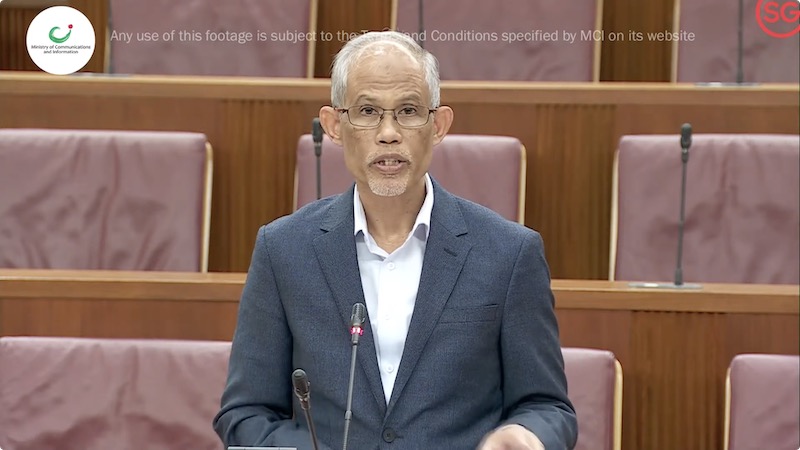
Mr. Speaker, I would like to propose that the substantive debates on both bills, this one and the Penal Code Amendment Bill, take place together. We will still have the formal second reading of the Penal Code Amendment Bill to ensure that procedural requirements are dealt with.
This bill gives effect to what PM announced at this year's National Day Rally: the Government will protect the definition of marriage from being challenged in the courts on constitutional grounds and will repeal Section 377A of the Penal Code. I will address the Government's longstanding position on marriage and family, what the Bill is and why we are taking this approach, and our unique approach to manage diversity in Singapore.
The PAP Government has been consistent in its strong support for the constitution of marriage and the family through its policies and legislation. One of the first laws enacted when the PAP Government came to power was the Woman's Charter in 1961, which defined and regulated civil marriages. The administration of Muslim Law Act, AMLA, soon after independence in 1966, provided the practice of Muslim law to regulate marriages between Muslims. Under AMLA, marriages must meet the requirements of Muslim law, including between men and women.
There is strong consensus in society that marriage is between a man and a woman, and children should be born and raised within such families. This is the view taken by many Singaporeans, whether religious or not and it is also the view that the Government believes in. Family is the foundation on which our society is built and sustained, with each generation raising the next to take its place. Mr Lee Kuan Yew wrote that Singapore depends on the strength and influence of the family to keep society orderly and family is the source of values for its society. Therefore, our policies reflect and reinforce this basic idea about marriage and family. We encourage parenthood within marriage, we do not support same-sex family formation, and we maintain our policy against bland and deliberate single parenthoods.
We have also taken steps to defend our pro-family policies when they are challenged. For example, in the adoption case UKM and AG, the Court did not agree with the Government that an adoption order should not be made if it resulted in the formation of a same-sex family unit. Parliament re-enacted the Adoption of Children Act 2022 to make clear that joint adoption applications can only be made by couples whose marriage is recognised in Singapore.
Adoption should not be used as a process to support the formation of same-sex families. We reiterate today Singapore's public policy is and has always been to uphold heterosexual marriage and promote the formation of families within such marriages.
We also recognise that there are single unwed parents and we empathise with the challenges they face. We extend government benefits that support the growth and development of the children, such as subsidies for education, health care, childcare and infant care, the foreign domestic worker levy concession and the child development account. HDB also assesses their requests for housing holistically based on their individual circumstances. We make a distinction between support and incentive, which is why we do not provide the baby bonus cash grant to single unwed parents.
Our public libraries also do not carry books which depict non-traditional family units such as same-sex families for very young children. MSF has also been actively promoting, educating and emphasising the importance of families through our public education programmes, inculcating family values such as love, care and concern, respect and commitment to each other in the family. The Families for Life Council has also rolled out parenting programmes in preschools, schools and the community. We dedicated 2022 as the year of celebrating SG families, in which PM announced an annual National Family Week.
Most recently, we had launched the Singapore Made for Families 2025. This plan will create a Singapore where families are valued and supported across different chapters of their lives. These efforts reflect the Government's deep and abiding commitment to the institution of marriage, as a union between a man and a woman to the formation of families within marriage.
Now I turn to this bill, which will make it possible to continue with these pro-family policies and the approach embedded in the bill. The Constitution is the supreme law of the land, and our other laws must not conflict with it. Overall, the Constitution is like the operating system for Singapore. The four key functions of the Singapore Constitution are it establishes the key organs of state like the President, Parliament, the Government, the judiciary, the public service, and regulates their powers with a system of checks and balances. It protects the sovereignty of Singapore. It provides for citizenship. It protects the fundamental liberties of individuals.
Specific to the fundamental liberties, they are found in Part 4 of the Constitution. They are Articles 9 to 16 and include, among others, liberty of the person and freedom of speech, assembly and association. Many of these rights are not absolute rights. They are subject to exceptions such as the maintenance of public order, morality and national security. If an individual considers that their constitutional rights have been infringed by a law or by the actions of the public body, he or she may bring a legal challenge in court.
Hence, it is possible for individuals to argue that our existing laws and policies on marriage are unconstitutional and seek a ruling from the court to that effect. Just as there have been challenges on the constitutionality of 377A, there can also be challenges to laws and policies related to marriage. The experiences of other jurisdictions show the perils of court-led change.
Most recently, in August 2022, the Indian Supreme Court observed that the definition of a family unit should be expanded to include homosexual relationships as well as unmarried partnerships of same-sex relationships. This did not even arise from a challenge of definition of family per se. It arose from a case when an employer denied a nurse her application for maternity leave because she had already taken leave to care for her husband's children from a previous marriage. Before this, in 2018, the Indian Supreme Court also struck down Section 377 of the Indian Penal Code, which similarly criminalised male homosexual acts. We also see the same trend in other jurisdictions.
In the US, for instance, controversial issues such as abortion are litigated and re-litigated in their courts. When the courts decide, things change overnight with drastic social repercussions that paralyse society. Hence, we are proactively safeguarding the institution of marriage and related laws and policies from being challenged in courts. These will allow the government to continue to make laws and policies which depend on heterosexual marriage as its foundation.
There have been questions on why the government is intervening now, why repeal, why even amend the Constitution. Perhaps we should leave things as they are. Let the courts decide when there is a challenge. Why do this now when there are other issues of concern, such as cost of living? That might be politically expedient. We acknowledge that there are, indeed, other issues of conscience to Singaporeans, such as cost of living. To use that as a reason for inaction might be politically expedient, but it would not be the right or responsible thing to do. We have assessed that there is a significant risk to our laws being struck down. We cannot just ignore the legal risk. This amendment is necessary and it is the right thing to deal with it now and not delay.
We have the mandate and the responsibility to govern, and we must put forward what we think is best for Singapore and Singaporeans. This includes making changes in a calibrated and careful manner that may not please everyone. We appreciate our courts for exercising wisdom and restraint on this matter. But a responsible government should not leave the courts to grapple with controversial social issues.
The role of the courts is to interpret and apply the law. It is not their constitutional function to settle political questions or rule on social norms and values. It is not their function to engage with the political, social, ethical and other dimensions of the issues. Nor do the courts wish to do so. Litigation is a zero-sum adversarial process with win-lose outcomes. It is unlike a political process where the interests of stakeholders can be conceded, accommodation can be sought to reach consensus. The courts also recognise that controversial social issues are best dealt with within the sphere of parliament.
This bill is what a responsible government carrying out its duty to the people of Singapore would introduce. It allows the political process to balance different interests and perspectives and does not pass the buck to the courts to rule on social issues which are best dealt with via parliament. Let me now elaborate on the provisions of the bill.
There will be a new Article 156 under the General Provisions of the Constitution. Clause 1 of the article makes clear that parliament can act to define, regulate, protect, safeguard, support, foster and promote marriage. For example, today the Women's Charter in AMLA defines civil and Muslim marriages respectively and makes clear that same-sex marriages are not valid. This clause empowers parliament to continue to make and amend laws for these purposes.
The interpretation of other constitutional provisions must recognise this. For example, in applying the reasonable classification test under Article 12.1, the courts must recognise that the promotion and safeguarding of heterosexual marriage are legitimate and permissible legislative objects.
Clause 2 of the article applies to the government and any public authority. It allows them to exercise their functions to protect, safeguard, support, foster and promote marriage. This includes, but is not limited to the following situations. HDB can implement public housing policies that give preference to married couples to support, foster and promote marriage. MSF, when they evaluate adoption applications, can recognise and take into account the public policy goal to foster and promote the formation of families within the context of marriage as defined in Women's Charter in AMLA. Curriculum for preschools and MOE schools centre on the values that reflect Singapore's mainstream society, that is, marriage as being a union between a man and a woman and children being born within marriage and raised within such a family construct. In the context of sexuality education, contents will be age appropriate.
Clause 3A provides that nothing in Part 4 of the Constitution sets out the eight fundamental liberties. It will invalidate any legislative definition of marriage as a union between a man and a woman. Clause 3B and Clause 4 respectively provide that laws and executive actions cannot be invalidated by Part 4 just because they are based on a heterosexual definition of marriage.
Some may ask why specify all the other fundamental liberties in Part 4 and not just Article 12. Mr Desmond will explain, but broadly, we need Article 156 to cover all of Part 4 so that it can apply to other radical legal arguments that may be brought in the future and based on other articles in Part 4. Article 156 will provide a strong shield. However, the shield is also precise, where it only protects the heterosexual definition of marriage and the laws and policies that rely on this definition. In effect, Article 156 is an exception to the fundamental liberties. There are already such exceptions.
For example, Article 39A empowers the legislature to create group representation constituencies, or GRCs, to ensure minority representation in Parliament. Article 39A-3 of the Constitution exempts any law regarding GRCs from being invalidated on the grounds of inconsistency with Article 12. Article 149-1 prevents the Internal Security Act from being invalidated by Articles 9, 11, 12, 13 or 14. Article 9-6 creates exceptions from Article 9 for the Criminal Law Temporary Provisions Act and for rehabilitative detention for drug addicts. Article 14-2 also has limits on Article 14, where one's right to freedom of speech, assembly and association is subject to public order, morality or security of Singapore. Article 12-3 makes clear that the right to equal protection does not apply to laws that regulate personal law or to laws and practices that restrict office or employment connected with affairs of any religion. Each case involves a balance between the fundamental liberties and countervailing interests.
In the case of Articles 156-3 and 4, we have struck the balance in favour of having the strongest protection for the heterosexual definition of marriage adopted by Parliament and the ability of Parliament and the Government to make laws and policies on the basis of this law. This reflects the importance of heterosexual marriage in our society. Some have commented that this is an ouster clause and could be subject to legal challenges. To be clear, the nature of Article 156 is not an ouster clause. Instead, it provides exceptions or limits to the fundamental liberties. As mentioned, such exceptions already exist today.
Let me now turn to another aspect that has come up in our engagements. They have been wide-ranging and we have heard from Singaporeans across various walks of life. I first want to take the opportunity to appreciate the different groups of Singaporeans who have written in and whom we have engaged before and after PM's announcements. These engagements include those with religious leaders, grassroots leaders, union leaders, LGBT groups, social sector professionals, youth groups and members of the public. Many have written in to share their views on this matter. Singaporeans have generally understood the need to respect, graciously and mutually accommodate each other's views and support the Government's approach.
Gay people appreciate the repeal of Section 377A, but express some apprehension of the implications of the constitutional amendments. Those in favour of the status quo have constructively shared their views and emphasised the need to safeguard the institution of marriage. Members whom we have engaged, such as leaders from the community, also support the proposed approach to keep the heterosexual definition of marriage while repealing 377A.
Many are concerned about cancelled culture, religious freedom, discrimination faced by those with differing views on this issue and the narrowing public space. To speak openly about it, these are important feedback and concerns that Mr Desmond Lee will also address when he speaks. Some express the wish to go further than what we are proposing, protecting the definition of marriage in our current laws. They want the definition of marriage to be enshrined in the Constitution. We understand that these calls come from a sincere belief in the sanctity of marriage and reflect a genuine worry that the institution of marriage might be changed in the future to include same-sex marriage. I thank those who have spoken up for taking a stand on what they think is best for Singapore. But the Government has to govern with principle.
Our view is that elevating marriage to the same level as fundamental rights in the Constitution would not be appropriate. As explained earlier, the Constitution should be for functions such as sovereignty and our system of governance. The institution of marriage and family is the bedrock of society, but to elevate it to the same level as fundamental rights would fundamentally change the whole complexion and schema of the Constitution. There are many important laws and principles that are not in the Constitution but are in Acts of Parliament. For example, national service in the Enlistment Act. Corruption is in the Prevention of Corruption Act. Zero tolerance to drugs is in the Misuse of Drugs Act. Home ownership is in the HDB Act. The definition of marriage is and will remain in the Women's Charter, Interpretation Act and AMLA. Importantly, this Government will not use our current super majority in Parliament to tie the hands of the future generations. Hence, the constitutional amendment will not prevent future governments elected by the people from amending the legal definition of marriage by a simple majority in Parliament, should they choose to do so.
This is how democracy works. But what we want to be clear is that the definition of marriage and related policies should not be determined by the courts. In fact, the constitutional amendment provides greater protection than today, not just for the definition of marriage, but also related policies. PM has said that this Government has no intention of changing the definition of marriage, nor the policies that rely on this definition. DPM Lawrence Wong, as 4G leader, has also said that the Government will not change them under his watch if the PAP were to win the next General Election. I reiterate these assurances in this House.
Ultimately, whether marriage in Singapore will remain as a union between a man and a woman depends on the consensus in society, shaped by the values we all hold. So long as society strongly supports the current definition of marriage, no Government will change the definition. If society's support erodes, no amount of legislation or constitutional arrangement will prevent change. On our part, the Government is doing all we can to promote social norms and values aligned to the current definition of marriage. But it's not something the Government can accomplish on its own. The transmission of social values to the next generation is something Singaporeans practice within their own families and with their loved ones.
Sir, the approach in this bill reflects Singapore's unique approach. Singapore is a secular state, but a multi-religious and multi-racial society. We are one of the most diverse societies in the world. There are different ethnic and religious groups, each with their own practices, customs, norms, convictions and beliefs. This diversity and harmony makes Singapore unique and is a key part of our Singaporean identity.
It's not easy to hold such a diverse society together. We are a young nation and all of us have taken great care and effort to preserve the harmony and peace that we have. We have been able to live together peacefully because we learn to understand, go beyond our own perspectives and graciously accommodate one another. This has been the Singapore way because we recognise what is best for our society.
Some may wish to maximise their own positions, but when this happens, it unsettles others and causes resistance, which will lead to further pushback and split our society apart. Singapore will not come out well in the end. It's therefore important that certain groups do not push beyond what is acceptable to our society. In most cases, society needs time to adjust to change, especially on issues that can polarise us. We may have different ideals and perspectives, but we are all Singaporeans and I hope this is an identity we can continue to be proud of. We forge a majority based on what we share in common and what unites us. This is why the Government has consistently emphasised the importance of preserving our common space, fostering good citizens and upholding the principle of equality regardless of race, language or religion. Only then can we be united as Singaporeans to achieve progress as a nation.
We are fortunate that our religious leaders understand the context of our diverse society and that communities trust the Government to treat all faith completely impartially. While they are honest and constructive in providing their views on matters of concern in their religious communities, they trust that laws and policies are in the national interest and not to favour one religion over another. This approach works because the Government on its part is fair and considers all perspectives, including those who are religious as well as those who are not religious. No one can act only for the interests of a few segments of the society, without regard for the rest.
Maintaining this approach requires wisdom and courage from everyone. As we see in other societies, it is very easy to yield to sectarian or tribalist views. Even if you do not win, you will be popular with them. But we need to guard against this. We also continue to protect all from scorn and harm. This includes homosexuals who are members of our society, our kids, our kin. Homosexuals have a place in our society and space to live their lives in Singapore, in our families. We should not exclude our loved ones who are homosexuals. In our communities, they, like other Singaporeans, have access to education and employment, to health care and social services, to protection from violence and harassment.
Workplace discrimination against homosexuals for reasons unrelated to their ability to do the job is a breach of the principle of fair and merit-based employment. Outlined in the Trappathai Guidelines on Fair Employment Practices. But on marriage and family, most Singaporeans wish to retain current norms. As I have mentioned before, it is the Government's view as well. As a society, regardless of your views on marriage, family or homosexuality, no one should feel unsafe expressing your views of fear being cancelled, bullied or discriminated against. It is dangerous for our society if we do not learn to respect others who hold differing views from us. This threatens the common space and Singapore will not be able to progress as a cohesive society.
Sir, I would like to now speak in Malay. In sharing the Government's intention to repeal Section 377A, we have engaged the Malay/ Muslim community extensively over the past year. This includes religious leaders, asatizah as well as community and Malay/ Muslim organizations. Many are concerned that the government's actions will lead to a sudden change in the principles of marriage, child-rearing, regulation of media content and curriculum, and the community's approach in a positive way.
Clearly, our society wants family institutions to remain our main pillar. I have given the Prime Minister an explanation that the approval of Section 377A will be followed by a delay and will be implemented at the same time so that the Parliament continues to have the right to establish marriage and family laws. It will allow the Government to continue to uphold the principles of marriage and the foundation that depends on it. This move will provide protection to the new laws that define Section 377A as a new challenge. This also means that other supports that take inspiration from our marriage resolution, including public housing subsidies and access to primary care for husband and wife couples, as well as financial incentives for husband and wife couples to have children, such as gifts, dowry, and baby bonuses, will remain.
In all the discussions, I am heartened by the attitude of our community leaders who are able to discuss calmly and rationally. Our well-informed Mufti and religious scholars have also given a definitive religious ruling on homosexuality – that in Islam, only sexual relations between a man and a woman in marriage are allowed. At the same time, Mufti also explained that the homosexual lifestyle does not exclude one from his or her religion. They must still be approached with compassion and kindness, especially by their own families. The open-mindedness of our community leaders and the wisdom of our religious scholars have averted situations in which the emotions of our people could have been deliberately heated up. We thank them all.
Sir, speaking now in English, I believe that many of us appreciate this secular approach that has provided Singaporeans security and safety, living together, and the freedom to practise our religion. Religious groups can continue to preach about homosexuality according to their religious beliefs. However, for all the diverse groups that may be for or against homosexuality, no one can violate the laws of the land or instigate violence or intimidation towards others or particular groups. We are protected by the constitutional right to be free to profess, practise and propagate our religion. But this right is not absolute. It is subject to considerations of public order, public health and morality. As Singaporeans, we must also have respect for each other as fellow citizens in exercising this right.
I want to make clear that our pro-family values and position are not a result of a majoritarian or religious approach. It is one that we share in common as Singaporeans and what this Government believes in and stands for. It is how we have come so far and will enable our society to perpetuate and flourish in the future. It is in the public interest and not the narrow interest of a specific religious group. Our community leaders, many of whom we have engaged on this issue, also support our pro-family approach and have helped families over the years. They will continue to have a critical role in maintaining social cohesion and rallying support for our family values. Such is the system that ensures the safety, survival and success of Singapore. No one group can have everything they want, all the time. The preferences of other Singaporeans matter too. As PM has said, we are seeking a political accommodation that balances different legitimate views and aspirations among Singaporeans.
Sir, we are taking a calibrated approach through these constitutional amendments which seeks to address the concerns that people may have on whether a repeal will cause a sudden shift. However, it is also done in a way not to tie the hands of a future Parliament. Above all, we want to ensure that Parliament should be the main platform to discuss sensitive issues and not the courts. We must also redouble our efforts to sustain this system that is broad about peace and harmony in our multi-religious and multi-ethnic society. As we advocate for what we believe in, let us also do it respectfully and in a knowledge that we are united by our Singapore identity.