← All speeches
28 November 2022
K Shanmugam
Speech at the Section 377A and Constitutional Amendment Debate
Nee Soon GRC, PAP, Minister for Home Affairs & Minister for Law
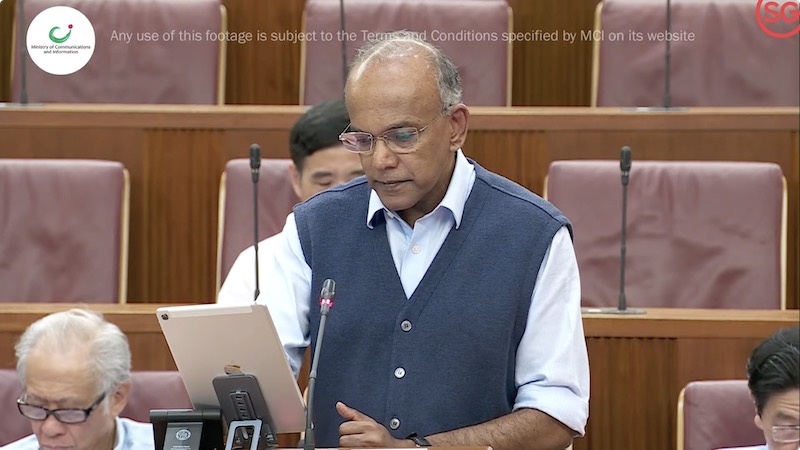
Minister Masagos has explained the reasons for the constitutional amendments, and I will now speak on the repeal of Section 377A of the Penal Code. We thought very carefully before moving on the repeal of this section and have engaged extensively with various groups. These groups include religious leaders, LGBT groups, community leaders, people who want heterosexual marriage as a social norm, youth groups, and members of the public who have written to us. We acknowledge the concerns of those who did not believe that Section 377A should be repealed, and their main concerns revolved around the consequences of the repeal and not the criminalisation of gay sex between men.
In considering the repeal of Section 377A, I will cover three areas: the historical context of Section 377A, the political compromise that has been struck in Singapore, and the reasons for now moving on the repeal.
First, the historical context. We need to understand why and how Section 377A became part of the law, whether it was a deliberate, considered decision, or perhaps more of happenstance. Section 377A makes it an offence for a male person, whether in public or private, to commit an act of gross indecency with another male. The section was introduced in 1938 when Singapore was a British colony, and Attorney General Howell moved the bill. He said that Section 377A was being introduced to bring our law in line with the UK criminal law. We have looked at the original UK law passed 137 years ago, which is Section 11 of the UK Criminal Law Amendment Act. Section 377A is almost a word-for-word copy of Section 11 of the UKCL.
We have not been able to find any background which explains why this section was introduced and made into law. What we did find was that it was introduced in the UK House of Commons at 2.30am in the morning, with very few MPs present, as a last-minute amendment to an entirely unrelated bill. It is unclear what the motives of the Member of Parliament, Mr. Henry Labouchere, were for introducing Section 11 into the bill on protection of women and girls. One school of thought is that he had intended it to be a wrecking amendment to derail and discredit the entire bill. Another school of thought is that he was fiercely homophobic and so he introduced the amendment. We have also noted that the explanation Mr. Labouchere gave in Parliament raises more questions than it answers.
The political compromise that has been struck in Singapore is that while it is still a criminal offence under Section 377A of the Penal Code, it is not actively enforced by the authorities. This was the position that Singapore had maintained for a long time.
And the third area – the reasons for now moving on the repeal – is because we understand that public attitudes have evolved over time and the society has become more open and inclusive. We also understand that Section 377A is a significant symbolic barrier to full inclusion and acceptance of the LGBT community. It is a symbol of discrimination and this has a corrosive effect. We have consulted extensively and have come to the conclusion that the time has come to repeal the section.
With your permission, Mr. Speaker, may I ask for the distribution of a folder which contains annexes 1 to 7 that I'm going to refer to? Members may also access the annexes through the SGPAL mobile app.
In addition to section 11 of the UKCL, the UK also had three other offences which were used sometimes to prosecute homosexual conduct. The first was sodomy. Sodomy was first criminalized under the Buggery Act of 1533, during the reign of King Henry VIII. The reason this law was passed is linked to a specific, important historical event in British history, and not because there was any specific intention to make sodomy a crime. I have in Annex 1 set out the background and context to how and why the Buggery Act was passed into law.
Prior to 1533, sodomy was considered an offence punished by the Church. It was tried in the Ecclesiastical Courts. In other words, not a crime defined by the state. It was an offence in a religious context to be dealt with by the Church. Members will know that Henry VIII broke with the Church in Rome, started the Church of England with him as the head of the Church. He wanted to reduce the power of the Church, and one of the ways he did that was to reduce the power of the Ecclesiastical Courts. And he did that by converting many of the Church's canon laws into secular laws. The Buggery Act was one such law that was brought over from the canon laws and made into secular criminal law. That way, the King's courts will deal with the matter, and the Church's jurisdiction was removed.
What happened thereafter is also useful to note. His daughter, Mary, was an ardent Catholic, so when she became Queen in 1553, she abolished the Buggery Act and moved it back to the Ecclesiastical Courts. Queen Elizabeth, another of Henry's daughters, succeeded Queen Mary five years later in 1558. There were questions on her legitimacy and her claims to the throne. She took several steps to establish her legitimacy, and one of the steps she took was to reduce the role of the Church by moving the laws out of canon laws and making them secular laws to show that she was following in her father's footsteps. So the Buggery Act thus became secular criminal law again.
So when you go through this history into the origins of the offence of sodomy, we see that it was introduced as part of a power struggle between Henry and the Catholic Church, and not because of any view that sodomy per se ought to be criminalised. I'm setting out this historical context factually, not suggesting that sodomy ought or ought not to have been criminalised.
The second act that was used to prosecute homosexual conduct was the offence of solicitating or importuning in public places for immoral purposes. This was first introduced under the Vagrancy Act of 1898. It was initially intended to target pimps, men who lift off the earnings of female prostitutes. In practice, however, the legislation was used almost exclusively to prosecute men who engaged in homosexual conduct in public, though male homosexuality was not discussed in Parliament when the bill was first introduced.
The third offence was the offence of indecent assault against males. This was first introduced under the Offences Against the Person Act 1861, and the offence criminalised homosexual acts committed against males without consent. It was introduced as part of a wider omnibus bill consolidating all offences against a person, and was included in the same provision as an offence of attempting to commit sodomy. Unfortunately, the provision and its overlap with existing homosexual offences and even male homosexuality were not discussed at all during the parliamentary debates.
So what we see is that these provisions, when they were first introduced, there was no substantive deliberation on whether there was indeed a need to criminalise homosexual behaviour, and it looks more like happenstance than a deliberate decision. Regardless, the criminal provisions were retained as part of UK's criminal law until the 1960s.
The UK government appointed a committee known as the Wolfenden Committee in August 1954 to review the laws relating to homosexual offences. That committee published a report in 1957. The committee stated that it was not charged to enter into matters of private moral conduct, except insofar as they directly affected the public good. The committee was only concerned with whether homosexual behaviour should be dealt with under criminal law.
The committee concluded that the function of criminal law was threefold. One, to preserve public order and decency. Two, to protect the citizen from what is offensive and injurious. And three, to provide sufficient safeguards against the exploitation and corruption of others. In their view, it was not the function of criminal law to intervene in the private lives of citizens or to seek to enforce any particular pattern of behaviour further than it was necessary to carry out these three functions.
The committee took the view that homosexual activities in private should not be criminalised. The committee stated, and I quote, unless a deliberate attempt be made by society through the agency of the law to equate the sphere of crime with that of sin, there must remain a realm of private morality and immorality which is not the law's business. To say this is not to condone or encourage private immorality. Moral conviction or instinctive feeling, however strong, is not a valid basis for overriding the individual's privacy and for bringing within the ambit of the criminal law private sexual behaviour of this kind.
The committee accepted that homosexual behaviour between males could have a damaging effect on family life. Let me pause there. I think many Singaporeans believe this as well, and we must acknowledge these feelings and beliefs. The committee, however, emphasised that this damage was no greater than many other activities which were sins and may be considered immoral but were not otherwise criminal offences.
The debate continued through the late 1950s and early 1960s. Law students may recall the well-known debate between Lord Devlin and Professor Hart on the Wolfenden Report. For members' reference, I have summarised the points they made in Annex 7. Eventually, Lord Devlin, who had argued for the criminalisation of shared morality, also said that private, consensual homosexual sex between adults should be decriminalised.
In 1967, the UK Parliament voted to decriminalise private, consensual homosexual sex between two adults. By that time, religious groups such as the Church of England and the Methodist Conference and members of both houses had publicly expressed support for a change. The members of the House of Lords who spoke in support of decriminalisation included the Lord Chancellor, he was the Speaker of the House of Lords and the Head of the Judiciary, as well as the Lord Archbishop of Canterbury, who was the leader of the Church of England and the Head of the Global Anglican Union, as well as various other bishops.
I would like to briefly cite the speech made by the Lord Archbishop of Canterbury. He stated up front that he believed that homosexual acts were wrong. He went on to say that the case for amending the law rested on reason and justice and on considerations of the good of the community. He said to amend the law was not to condone the wrongness of the act. It, however, put such acts in the realm of private moral responsibility. He believed that the law as it stood gave a sense of injustice and bitterness which helped morality no more than would a law which made fornication a crime. He further agreed with his predecessor that having such a law created fear, secretiveness and despair in gay persons who did not dare to seek help in case they exposed themselves and their friends to criminal proceedings.
I would add that not all religious groups were in favour of the change. Some, such as the Church of Scotland and the Church of Ireland and the Baptist Church, objected to the reform.
In 2003, all of the United Kingdom's laws that specifically criminalised male homosexual behaviour, including the offence of gross indecency, were fully repealed.
Before I move on from the UK, I would like to highlight the context of Northern Ireland. Northern Ireland was and is part of the UK. However, the partial decriminalisation of homosexual conduct in the UK in 1967 only applied to the mainland and did not apply to Northern Ireland. Northern Ireland's path to decriminalisation started instead from the courts. After 14 years, in 1981, the European Court of Human Rights found that criminalising private homosexual conduct between men was an unjustified interference with a person's right to respect for his private life and was a breach of the European Convention on Human Rights.
UK was bound by that decision and UK parliament decriminalised private consensual homosexual conduct between adults in Northern Ireland in 1982. However, at that time Northern Ireland society was deeply religious, largely conservative, and the majority of the population of Northern Ireland opposed the decriminalisation, including most of the Protestant churches as well as the Roman Catholic Church. The bill was opposed by all of the 12 Northern Ireland MPs in the UK parliament, but nonetheless it passed through both houses by majority vote.
Northern Ireland's experience shows how a court decision can force a change, even though a society is not ready for such change, and I'll come back to this later.
Today, homosexuality remains a deeply divisive issue around the world. This is true even within more religiously homogeneous communities such as the Church of England and the global Anglican Church. If you look at the Anglican Communion, it comprises 42 member churches. It's the third largest Christian communion after the Catholic and Eastern Orthodox churches. For decades, there has been a strong difference of views within the Anglican Communion on whether same-sex unions can be legitimised and blessed and whether persons living in same-sex relationships can be ordained.
Some Anglican churches in the global north, such as the United States and Canada, are increasing in number and increasingly supportive of homosexuality. They allow same-sex marriages and ordain persons in same-sex relationships. However, several Anglican churches from the global south do not agree with this approach. And this has resulted in the creation of the Global Anglican Future Conference, or GAFCON, in 2008, led by the more conservative Anglican bishops and leaders.
The Church of England LGBT issues have also been the subject of intense debate for decades. I mentioned earlier that the Church of England had supported the partial decriminalization of homosexual conduct in the UK in 1967. But actually, within the Church of England, there was no consensus. Church was more or less equally split on the issue, and it was put to a vote of its 735 members, 155 voted in favor, 138 voted against, and the rest either absented themselves or abstained.
So there continues to be strong differences and viewpoints on this issue, as members may have seen from recent media reports. So what does all of this show?
First, that even within a single religious community, it is difficult to agree on the right answer, assuming there is one, on the issue of homosexuality. Second, that homosexuality is a topic that continues to raise strong viewpoints. Third, that if we do not handle this carefully, homosexuality can be a deeply divisive issue, even among those who share a common belief.
Some of the international media outlets that report on these issues often gloss over these differences. They gloss over the problems that societies face, don't understand the need to deal with these issues sensitively, with understanding they present views as if they are settled, and that anyone who has a negative view of male homosexuality is a bigot and is wrong.
If you look at the US, it is considered more accepting of LGBT rights than many other countries. But the country is internally split over this issue. For example, in the Republican states of Florida and Texas, there remain strong objections to LGBT rights. The Republican Party of Texas recently adopted anti-LGBT positions into their party platform. They state, and I quote, homosexuality is an abnormal lifestyle choice. We believe there should be no granting of special legal entitlements or creation of special status for homosexual behavior, regardless of state of origin. And we oppose any criminal or civil penalties against those who oppose homosexuality out of faith, conviction, or belief in traditional values. No one should be granted special legal status based on their LGBTQ plus identification.
But other Republicans have different views on homosexuality. A survey of more than 22,000 people by the Public Religion Research Institute in March of this year found that 48% supported same-sex marriage and 50% opposed it. These were persons who identified themselves as Republicans.
If we look at, say, Italy, I will not go through in detail. I have set out what has been happening in Italy in Annex II. You will see the divisions. I have laid out examples of how within the same religion, the same denomination, the same churches within the denomination, and in wider society, within some Western countries, even those who are often described as liberal, the issues remain deeply divisive.
To be clear, it is not the exact same issue in all these communities. In some, the division is about homosexuality in itself. In some, it is about the roles of LGBT people, for example, in church ordination. And in others, it is other related issues, like same-sex unions that are divisive.
Let me now say something about global trends. Around the world in several countries, as well as in jurisdictions and territories, which are not quite countries, several have decriminalized their version of Section 377A, including Commonwealth countries and Southeast Asian countries. Some have decriminalized it through the parliamentary process. Some have had their Section 377A equivalent struck down by the courts. But there are also some countries which continue to keep the criminal laws.
Mr. Speaker, with your permission, I would like to display some slides on the screen. Slides one and two of Annex III show the countries, and other countries and territories and jurisdictions, that have decriminalized homosexuality, and those which have not done so. Because not all the places in these two slides are countries. And slide three shows the same for Asian states and places and jurisdictions. We can see that across the world, there are different approaches, even though there is a trend towards decriminalization.
In Singapore, we look carefully at international trends, but we don't simply follow such trends. We chart our own path based on what we believe is in our own best interest. And we have made it clear to foreign governments and companies that these are political, social, and moral choices for Singaporeans to decide, and that they should not interfere. For example, last year in 2021, the US Embassy co-hosted a webinar on LGBT rights with a Singaporean LGBT organization. MFA spoke to the embassy to remind them not to interfere in our domestic politics. More recently, in August this year, US House Speaker Nancy Pelosi issued a statement when she was in Singapore, asking business groups to support the LGBT community in Singapore. MHA issued a statement reminding foreign businesses to be careful about advocating on socially divisive issues in Singapore. We would also say to US politicians who feel very strongly about these issues, that perhaps they should first try and persuade the people in Texas and other such places before they issue statements in Singapore.
In Singapore, Section 377A was substantively debated in Parliament 15 years ago in 2007 during the second reading of the Penal Code Amendment Bill. Over the course of two days, 16 MPs and NMPs came out to speak on Section 377A to argue for and against its retention. It was a long debate. I have summarized the different positions taken by the MPs and NMPs in Annex IV. Prime Minister spoke and stated the government's position. He said that Singaporeans as a whole remained largely conservative. Majority wanted to keep Singapore a conservative society with heterosexual, stable families. But at the same time, there was a growing science-based evidence that sexual orientation was substantially inborn.
Gay people must have a place in society, and they are entitled to their private lives. But there were still very different views amongst Singaporeans on whether homosexuality was acceptable or morally right. Thus, LGBT advocacy should not set the tone for the rest of Singapore society. We will try and maintain a balance, said the Prime Minister, to uphold a stable society with traditional heterosexual family values, but with space for homosexuals to live their lives and contribute to society.
He added that we would continue to retain Section 377A, but not proactively enforce it. It was a very Singaporean way of dealing with a situation which best fitted with the way our society was. PM also reminded MPs that Section 377A was inherited from the British, and that Asian societies which were similar to ours did not have such laws, not in Japan, not in China, not in Taiwan. But if we forced the issue, it would divide and polarize our society. It would lead to even less space for the gay community in Singapore. Therefore, it was better to let the situation be evolved gradually. It was a compromise. It was better. And it has worked for Singapore in the past 15 years. We managed to maintain some harmony, while many other societies have become deeply divided on these issues over the same period.
Now, let me now move on to explain why we propose to repeal Section 377A. There are two main reasons. First, it is the right thing to do, and society is more ready now for the repeal. Second, there is a significant legal risk that the courts will strike down Section 377A if we left it alone and did nothing. Let me deal with the first reason.
In some religions, homosexuality is considered a sin. As members heard earlier, some sins are crimes, but not every sin is a crime. Our position in Singapore is for a conduct to be a crime, there should generally be a public order or public interest issue. It's broadly similar to the position set out by the Wolfenden Committee, which I referred to earlier. Basic function of criminal law is to preserve public order and decency, to protect citizens from what is offensive and injurious, and to provide sufficient safeguards against exploitation and corruption of others.
In Singapore, like in many other places, it is generally not the function of criminal law to intervene in the private lives of citizens. As we consider this question, it is also important to understand what will remain criminalised, even if Section 377A is repealed. First, non-consensual sexual assault by males against other males will obviously be an offence, and it's a serious offence. Two, sexual acts committed by males against young persons, again, a serious offence regardless of consent. Three, sexual acts between two males committed in public that offence public decency will remain an offence.
The maximum penalty for the first two offences is in fact more severe than the maximum penalty under Section 377A, and rightly so, this government takes an extremely stern view against all non-consensual sexual offences and in respect of sexual offences against minors. The only thing that will no longer be an offence after the repeal is consensual male adult homosexual conduct conducted in private. Such conduct does not raise law and order concerns.
The time has come for us to remove Section 377A. It humiliates and hurts gay people. Most gay people do not cause harm to others; they just want to live peacefully and quietly and be accepted as part of society, the same as any other Singaporean. They are our family, our friends, our colleagues and they deserve dignity, respect, and acceptance.
To a gay person, even if Section 377A is not enforced, it is there, memorialized in law, a sword hanging over his head, a daily reminder that every time he engages in private sexual activity behind closed doors in the sanctity of his bedrooms, he is nevertheless a criminal. We have to ask, is it fair that gays have to live in this way? This is not something we should accept, even if we personally disagree with homosexuality.
So I will say, let us start to deal with these divides, heal these divides, remove their pain. Section 377A should no longer be in our books. Repealing Section 377A makes it clear that gay people are not criminals. Compared to 2007, we are now at a stage where our society can accept the repeal of Section 377A. From our engagements, we see that most Singaporeans accept that sex between men should not be a crime. Even those who want to retain Section 377A do not want to see it actively enforced.
But as has been stated in and out of Parliament, we must and we will take steps at the same time to deal with the possible consequences of the repeal. The constitutional amendment is one big step. There are others, because some consequences would be unacceptable to a significant section of our society. The government has explained its position about dealing with consequences. Members can refer to Annex 5 for a summary of what the Prime Minister, Deputy Prime Minister, Lawrence Wong, various ministries, as well as I, have said on the matter.
Now let me move on to the second reason for the repeal, and that is that leaving Section 377A alone in the books carries a significant legal risk. The courts may strike down Section 377A in the future. And if the courts strike down Section 377A, it will be a binary process. They cannot deal, the courts cannot deal with all the legitimate concerns about the consequential effects of the repeal, which many are concerned about.
Why do we say there is a significant legal risk of Section 377A being struck down? Let me take members through two Court of Appeal decisions. The CA has dealt with Section 377A twice in the last 10 years, first in Lim Meng Suong versus Attorney General decided in 2014, and second in Tan Seng Kee versus Attorney General decided earlier this year, 2022.
Both decisions took quite different approaches on two issues. First, a procedural issue, and second, a substantive issue. In Lim Meng Suong, the court made a procedural decision in 2012 and a substantive decision in 2014. The procedural decision was on standing, whether the applicants had Locus Standi or standing, whether they were entitled to make the application. The Court of Appeal said that the applicants did have Locus Standi because there was a real and credible threat of future prosecution. The CA further added that even if no prosecution was contemplated, the applicants could bring the action they had standing because of the very existence of a law which is unconstitutional.
Members should note that CA in 2012 said the very existence of 377A gave Locus Standi for an applicant to make an application. On the substantive issue, the Court of Appeal said that Section 377A did not contravene either Article 9 or Article 12 of the Constitution. On Article 12, the Court of Appeal applied a legal test known as a reasonable classification test to come to that conclusion. It said that Section 377A satisfied that test and did not violate Article 12. The CA therefore dismissed the application in Lim Meng Suong on the substantive basis that Section 377A was not unconstitutional even though the applicants had Locus Standi to bring the challenge.
Section 377A was then challenged again in the courts in Tan Seng Kee. It was again argued that 377A contravened Articles 9 and 12. In addition, 377A was also challenged on the ground that it contravened Article 14 of the Constitution, which guaranteed the right of freedom of speech and expression. Court of Appeal dismissed the challenge.
How and why the CA came to that decision and what it said is important. This time in Tan Seng Kee, the appeal was dismissed on procedural grounds on the basis that the applicants lacked Locus Standi to challenge Section 377A. And the court deliberately did not rule on one of the substantive grounds.
First on the procedural issue, the CA reversed itself on the Locus Standi point and took a different view from its earlier decision in Lim Meng Suong. The CA said that there was no Locus Standi because the AG had said that absent other factors, there would generally be no prosecution under Section 377A where the conduct was between two consenting adults in a private place. On this basis, the CA said that Section 377A was unenforceable until the AG gave clear notice that he intended to enforce 377A.
Thus, according to the CA, the applicants did not face any real or credible threat or prosecution under 377A. And so they did not have standing to bring the case. In Lim Meng Suong, the Court of Appeal had said that the very existence of 377A was enough to give Locus Standi. In Tan Seng Kee, the Court took a diametrically opposite view.
Members will note one Court of Appeal can disagree with another Court of Appeal. I'll come back to this. It is also significant to see what the Court of Appeal had to say in Tan Seng Kee on the substantive issue as to whether Section 377A was unconstitutional. The CA actually did not need to give any view on the substantive merits of the challenge because it had already said that the applicants could not bring the case. But it nevertheless went on to give its views. And so with your permission, if I can show in a slide some basic points they made.
The CA first considered the arguments in relation to Article 9 of the Constitution on life and personal liberty and said quite clearly that 377A did not violate Article 9. The Court then considered whether 377A contravened Article 14 on freedom of speech and expression. And it said, no, there was no contravention. Then it considered Article 12, the Equal Protection Clause. On this, the CA took a different view from its previous decision in Lim Meng Suong. And the CA said that there were two ways to apply the reasonable classification test. One is the approach adopted in Lim Meng Suong in 2014. And the second was the approach adopted in a 2021 case in Syed Suhail.
The Court of Appeal went into a detailed comparison between the two approaches. Court said that if the Syed Suhail approach is taken, then Section 377A might fall afoul of the reasonable classification test. If you see what the Court of Appeal has said in red, one can then conclude that it said the differential embodied in 377A, namely male-male sex acts, lacks a rational relation to legislative object of reflecting societal disapproval of homosexual conduct in general or safeguarding public morality generally.
In plain language, what this means is Section 377A is probably unconstitutional if the Syed Suhail test is applied, even though the Court of Appeal was careful to say Section 377A might be unconstitutional if the test in Syed Suhail was applied. Lawyers will know, at least some lawyers will know that the Court of Appeal has, in fact, in subsequent cases applied the Syed Suhail test.
After the decision in Tan Seng Kee, the Court of Appeal has applied the Syed Suhail test and approached in two other cases, in May and August of this year, in May 22 in Datchinamurthy and in August in Terry Xu's case.
What does all of this mean in plain language? It means that if another constitutional challenge against Section 377A is brought before the Court, the Syed Suhail test is likely to be applied. And if that test is applied, Section 377A is likely to be struck down on the grounds that it breaches Article 12 of the Constitution.
Some members could say, well, we accept what the CA has said. But the CA in Tan Seng Kee this year also said there is no Locus Standi to bring the challenge. So as long as the Attorney General maintains a current position and does not reassert the right to prosecute cases under 377A, then there should be no risk that 377A would be found unconstitutional because no one would have standing to challenge it in the first place.
Taking such a view, if I can give an analogy, it's like letting a small boat sail in choppy waters surrounded by rocks and hoping that the boat won't crash into the rocks.
There are two major risks in taking this view. First, just because the applicants in Tan Seng Kee did not have standing does not mean that no one else will have standing in a future case. For example, persons who had been convicted in the past under 377A, they may well have a case for standing. I don't want my speech to be read as giving a right to people. It's my view. But such persons may well have a case for standing by arguing that their rights have been violated, and therefore that they have sufficient interest to challenge the constitutionality of 377A. They will not be able to directly reopen their convictions, but they can ask for 377A to be struck down on the basis that this will give them vindication.
And the very fact that they had been convicted under unconstitutional legislation gives them the standing and to allow them to redress the hurt of their conviction. And if you look at Tan Seng Kee, the CA was very careful to circumscribe what it said about who had Locus Standi. It expressly stated that its decision on Locus Standi will not, for example, prevent police from investigating conduct under 377A, if you look at the parts in red.
In reality, there is a broad universe of cases where the police may have to investigate, because before investigating, they might not know exactly what the facts are. So you can't rule out the possibility that in some situations, a person involved in the investigations brings a challenge. And you cannot rule out that a future court could find this to be sufficient grounds for a person to have Locus Standi to challenge 377A.
And of course, there is the other risk. The CA can always change its mind on Locus Standi just as it did between Lim Meng Song and Tan Seng Kee. It changed its mind precisely on this point of Locus Standi. So we cannot proceed in the belief that the CA will certainly not change its views in the future.
In September this year, I took part in a law forum organized by the Singapore Academy of Law and the Law Society, which discussed the implications of Tan Seng Kee and the legal risks surrounding 377A. There was a panel discussion moderated by the dean of the SMU Law School. Panel and audience included the dean of SUSS Law School, legal scholars from our law faculties, presidents of the Law Society past and present, and senior counsel, and distinguished and senior legal experts. Panel and the audience were pretty unanimous on the legal risks surrounding section 377A in light of Tan Seng Kee. Members can refer to annex six for key points and views that were shared at the law forum.
As the attorney general and I looked carefully at the Tan Seng Kee judgment, and as the prime minister said during National Day Rally, the AG and I have advised the government that in a future court challenge, there is a significant risk of section 377A being struck down.
So let us be clear. One, after the Tan Seng Kee judgment, section 377A is at significant risk of being struck down in a future challenge. And two, we cannot simply hope that the point on Locus Standi is enough for the government and parliament to do nothing. That will be just wishful thinking. And wishful thinking is no substitute for careful legal analysis of proper policy.
If we engage in wishful thinking, and if section 377A is struck down in the courts, that could lead to a whole series of consequences which would be very damaging to our Singaporean society. I'll come back to this. But before I do that, it is useful to look at what happened in India as an illustration.
In India, the section 377 was challenged on grounds broadly similar to those used to challenge our 377A in Singapore. In 2009, the Delhi High Court ruled that section 377 was unconstitutional. The court then said that its decision would apply only until parliament repealed section 377 as per the recommendations made by a law commission in the year 2000, nine years before the decision of the court.
After the judgment, however, the Indian parliament did not do anything about the law. The government also did not appeal the High Court judgment. Instead, an appeal was brought by some organizations and individuals. On appeal in 2013, the Indian Supreme Court overturned the High Court decision, saying there was no constitutional infirmity. So section 377 was held to be constitutional. Nonetheless, the court emphasized that parliament was still free to consider the desirability and propriety of deleting section 377 from the Indian penal code, or amending it to exclude private acts between consenting adults. Parliament, however, did nothing after this decision.
In 2016, a fresh application was filed in the Indian Supreme Court to again challenge the constitutionality of section 377. In 2018, the Indian Supreme Court ruled section 377 to be unconstitutional with regards to consensual acts between adults. It reversed its 2013 decision on the grounds that section 377 violated the right to life and liberty, which is Article 9 of our constitution, that it violated the right to equal protection, which is Article 12 of our constitution, and that it violated the right to freedom of expression, which is Article 14 of our constitution. And the court found that section 377 did punish homosexuals arbitrarily.
The court said that a subjective notion of public or societal morality which discriminated against LGBT persons and subjected them to criminal sanctions simply on the basis of an innate characteristic ran counter to the Indian constitution and could not form the basis of legitimate state interest. Court held that parliament's failure to delete section 377 was not in any way a good reason for the court not to strike down section 377.
When a provision violated a constitution, the courts must strike it down. Fast forward to this year, 2022, as Minister Masagos has mentioned in his speech, the Indian Supreme Court has expanded the definition of family to include same-sex relationships. The court held that such atypical manifestations of the family unit are equally deserving of protection.
What is the lesson here? When parliament does not act when it should act, then we may leave the courts with no choice. If fundamental constitutional rights have been violated and yet parliament abdicates its duties, then the courts may have no choice but to act. And what will happen, what can happen, if the courts strike down section 377A?
Then our laws defining marriage as being between a man and a woman and our laws and policies based on that definition could also be at risk sometime in the future. For example, the heterosexual definition of marriage could be challenged on the basis that it is against article 12 of the constitution. It could be argued that equal protection means we cannot discriminate against same-sex couples in the same way that section 377A can be said to discriminate against gay persons. It could be asked, why should a marriage only be between a man and a woman? Why can't a marriage between two men or between two women be considered a marriage? Some places, jurisdictions like Taiwan and some countries like the United States, have ended up legalizing same-sex marriage through court challenges. As mentioned earlier, India's Supreme Court also recently said that family will include same-sex relationships.
In Singapore so far, the courts have recognized that parliament as the elected branch of government is better suited to resolve such difficult societal issues. In parliament, there can be consultation, discussion, debate. Considerations going well beyond the law can be taken into account, whereas courts can only consider the legal issues. Consensus can be forged in parliament to bridge divergent viewpoints. Open-ended resolutions are possible instead of binary win-lose outcomes.
There are some who have said, since our courts have recognized what belongs to the political process and what belongs to the judicial process, it is unlikely that the courts will ever strike down Section 377A. In other words, we can just take the easy way. We don't need to decide. We just let things be. But such an approach would be irresponsible and wrong.
Members may know that the Court of Appeal has said that although the 2007 compromise was inherently political, legal standards do still exist and may be applied to judge the legality or constitutionality of Section 377A. So, we should not assume that the courts will never strike down 377A just because the government chooses to retain it.
Our system has only worked well in all these years because all three branches of the government, parliament, the executive, and the judiciary work within their respective boundaries and have fulfilled their respective roles. But, if parliament does not do its duty, if parliament does not deal with the law which is likely unconstitutional, then the courts may have no choice but to do what they don't want to do. It would be much easier for us as MPs to leave this to the courts; to pretend that these issues do not exist and need not be talked about after the Court of Appeal decision in Tan Seng Kee. But, this government will not take that approach. As elected representatives of the people, we cannot do that. If we see a risk that a law may be found unconstitutional, it is our duty to act and deal with it in parliament, both because it is our duty to do so and because taking the easy way out would have serious negative consequences for our society.
It will be very bad for Singapore. As I said earlier, the court processes are adversarial by nature; their decisions are binary, zero sum. You either win or you lose. There is no middle ground, no balancing of competing interests. The courts cannot consider competing social norms and social consequences of their decisions. Whereas in parliament, we are now proposing amendments to the constitution to further protect heterosexual marriage.
Going further, if the definition of marriage is changed through a court challenge, there can be a cascading effect. Housing policies can be challenged, media content rules could be challenged. If we, such changes through the courts are not in our interest. If we want to act in the best interests of Singapore, then we have to move on this, given the legal analysis.
We can look at the United States to see how court decisions on such issues can seriously affect the fabric of society, divide the society, unleash partisan views on both sides of the divide. If we have that in Singapore, our social fabric will fray. If the government and parliament do not take responsibility and instead stand by and do nothing, then litigation could change our societal norms very quickly.
I have given two reasons for proposing the repeal of Section 377A. One, we should do so because there are no public order issues that are raised from such conduct, so it should not remain criminal. But I accept that MPs and others may disagree with that, that even though there are no public order issues, they may feel that there are other reasons for keeping the law. And I accept that people can and do legitimately have such views. But, the second reason I have given, the legal consequences, that's not a matter of conscience. It's a policy question. It requires each of us to think carefully and apply our minds.
Knowing all the risks and refusing to take a position or be clear in how we will deal with it is avoiding our responsibilities as MPs, basically passing it on to the courts. It is easier politically, but it is also worse for Singapore and Singaporeans. As I said, if we, such as the government and parliament, do not take responsibility and instead stand by and do nothing, then litigation could change our societal norms very quickly.
So Mr Speaker, I emphasize that if we want to act in the best interests of Singapore, then we have to move on this, given the legal analysis. It is like a train approaching. Question is, are we prepared to take the appropriate steps to save and safeguard what is important for our society? Whether we have the courage of our conviction, which should be to do what is good for Singapore. So Mr Speaker, I say to all members, let us do what is right, do our duty, what is expected of us in parliament, and take a path forward on this difficult issue. Thank you. Mr Speaker.