← All speeches
28 November 2022
Christopher de Souza
Speech at the Section 377A and Constitutional Amendment Debate
Holland-Bukit Timah GRC, PAP, Deputy Speaker
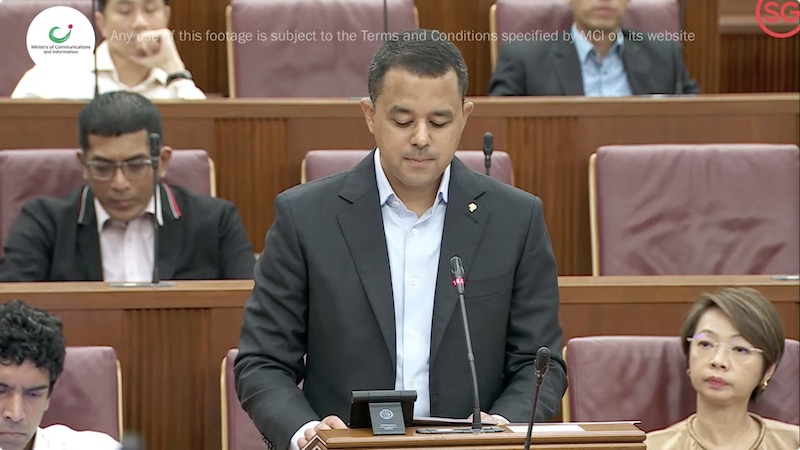
Mr Speaker Sir, thank you for allowing me to speak. Many Members in this House have known my long-standing support for the institutions of marriage and family, which I believe deserve continuing protection. I must discharge a duty today to answer two questions: what is that duty and how can I ensure that the carrying out of that duty works to the best for Singapore?
For this, my starting point is to go back to 1962 and quote Mr Lee Kuan Yew. In his speech to an audience from the University of Singapore, Mr Lee said the phrase 'law and order' should be modified. It should read, 'Order and Law'; because his view, and I think it is a correct view, is that without order, then laws become useless. Allow me to quote Mr Lee: “Those of you who are just embarking on the study of the law will learn the phrase law and order. In a settled and established society, law appears to be a precursor of order. Good laws lead to good order. But the hard realities of keeping the peace between man and man and between authority and the individual can be more accurately described if the phrase were inverted to order and law. For without order, the operation of law is impossible.” By inverting the phrase, Mr Lee showed how one must establish order first before laws can work.
Why is this a good starting point? Because what we are debating today is the order of things and the order from which all relevant laws and policies should be construed. Some use the phrase societal norms, some use the phrase social mores; I would use the term the 'order of things'. Mr Speaker, we are deciding the order of things today. Even as we are debating removing a law, we are also debating strengthening the order of things by virtue of an amendment to the Constitution. That is a very significant move.
Do I believe that there is a significant risk that Section 377A will be struck down by the courts in a future legal challenge? The AG has said so. The Minister for Law has said so. These are views that must be taken seriously. So I have thought long and hard about this matter and agree that there is a significant risk that Section 377A will be struck down by the courts in a future legal challenge.
Therefore, Parliament has to act now. We must analyse, deliberate, look into our own selves and make the hard legislative decisions. As members of this House, we have a duty to decide and reinforce what we desire to protect, given the significant risk that Section 377A may be struck down.
For this, I now turn to the amendments of the Constitution before the House today. What does the constitutional amendment do? The Bill states, the legislature may, by law, define, regulate, protect, safeguard, support, foster and promote the institution of marriage, and then clause 3 states, nothing in part 4 invalidates a law enacted before, on or after the commencement of this Bill, by reason that the law defines marriage as a union between a man and a woman.
The amendment to the Constitution is clear as to what it seeks to protect. I support it. Why? I believe that the institution of marriage, as defined as the union between one man and one woman, is the basis upon which our society is built. It is something we must protect. It must not be diluted. Marriage is the union of a man and a woman. For centuries, this union has been the foundation of societies. Children and society as a whole flourish when marriages are supported and the resulting family unit is strong.
The Prime Minister has said in 2007, 2013 and 2016 that the traditional family unit should form the basic building block of our society. PM stated as recently as three months ago, we have upheld and reinforced the importance of families through many national policies and we will continue to do so.
Mr Speaker, the amendment to the Constitution strengthens this foundation. It states clearly that marriage is between a man and a woman, and it follows that this is the basis on which family is built. By constitutionalising this, we are entrenching our values on what is the core, the base, the order of things, from which all other relevant laws and policies in our society take bearing. It is the beacon, the guiding light.
As a legislator, I see this inclusion and amendment to the Constitution as a deliberate and positive step. By making this amendment to the Constitution, it means that we are also protecting all our social policies that flow from this definition. As PM has said in the National Day Rally, this includes policies on public housing, education, adoption regulations, advertising standards, firm classification. Such a position has been echoed by various ministries in press statements or by ministers in response to press questions since the National Day Rally.
What does this mean? One, the only form of marriage that is recognised in Singapore is the union between one man and one woman. No other form of marriage is recognised in Singapore. A religious teacher, an ustaz, imam, priest, pastor, bishop, rabbi, or men, and women of any religion cannot be prevented from teaching what their faith teaches about marriage and about homosexuality. If practising homosexuality is not condoned in a particular faith, the religious leader can state so.
Two, spousal rights can only be granted within the context of a heterosexual marriage. Three, education in school, particularly sex education, should affirm heterosexual marriage as the norm and the bedrock of family. There is no room to argue that because Section 377A is being repealed, that this somehow provides a gateway or a licence to teachers to promote or normalise homosexuality in schools in Singapore. The repeal does not provide such a licence.
Four, high age ratings will apply to all media that contains homosexual content. Advertising content should not affirm homosexual unions in any way. Five, housing policies will prioritise allocation and grants for married couples, and here marriage means a union of a man and a woman. Six, library books for children, both physical and digital, should not have content depicting or affirming homosexual unions. Seven, as for adoption, there cannot be a case where a civil union recognised overseas gives a couple in the civil union the ability to adopt under our laws. Eight, and for the complete avoidance of doubt, civil unions and civil partnerships are not recognised in Singapore.
Sir, this is not an easy speech for me to deliver. I have spoken with people who want Section 377A to be retained at all costs. They have a right to their view. I have spoken with people who want to do away with Section 377A and open the gates to changes for all institutions – marriage, adoption, the works. They too have the right to hold those views. But in the final analysis, I have to make my own decision on this difficult issue. Believe me, it is difficult. I too have close friends who have same-sex attraction.
To take a public position on such a difficult issue is not easy. But I cannot shy away from facing difficult issues. And what I have shared in this speech is my position for Singapore.
Is this decision-making a struggle? Yes, but in this struggle is where I belong. We, all of us here, have to make a deep effort to make the right choices in Singapore and for Singapore.
Sir, with your permission, I move to my second last point. What we are debating today in this House on Singapore soil is squarely a domestic issue. Other countries can choose how they want to shape their societies. But other countries should not impose their choices on us, no matter how well-meaning they perceive themselves to be. Speaking plainly, let us guard against covert and overt foreign influence in our domestic affairs.
Allow me, sir, to end with the need for unity. Unity has been a powerful force in modern Singapore's unprecedented history. It must remain a part of our future. Why, in my view, is the aspect of unity so important today? I offer three reasons. One, there are people in our society who hold strong views on these issues. Therefore, there is a potential here for Singapore to be torn apart by discord. Two, my hope is that Singaporeans can discuss our views on these issues peacefully. Where we disagree, let us express such disagreement respectfully and politely.
What we are doing today in this House is to entrench what we seek to protect and remove a law that has a significant risk of being struck down. Three, by choosing to deal with this in Parliament, we are taking a deliberate and considered approach. Parliament, being made up of elected members, has the requisite mandate to deal with these issues. And Parliament can do so with dexterity. No other institution can carry through such a legislative manoeuvre.
It is hoped that the choice of deploying Parliament to deal with this issue is the best path for unity for our society. Unity. It is very important.
Sir, in conclusion, while there is no perfect solution, I think the formula we are putting forward today both protects what is of vital importance to our nation and gives Singapore the best chance at unity. So let the decorum, tone and respect that we displayed during this debate in this House set a good example to all Singaporeans of how to deal with such difficult and sensitive issues in future. My prayer is that we will not be torn apart by discord, but instead stay united as one nation. In all our deliberations, present and future, in all our debates, present and future, and in all our decisions, present and future, let not the unity of our nation be lost.
Thank you very much.